

Why Your Inverter Choice Matters More Than You Think
You have spent weeks researching solar panels. You know the difference between monocrystalline and polycrystalline. You have calculated your subsidy. You have chosen between Waaree and Tata Power Solar. But when the installer asks, "Which inverter do you want—string, hybrid, or microinverter?" you freeze.
Most Indian homeowners obsess over solar panel brands and ignore the inverter—the actual brain of your solar system. This is a costly mistake. Here is why: Your premium Waaree panels might generate 100% power, but a low-quality or wrong-type inverter can waste 10-15% of that electricity during conversion. An inefficient inverter turns your ₹3 lakh solar investment into a ₹2.55 lakh performer.
Worse, inverters fail much faster than panels. Solar panels last 25-30 years with minimal degradation. Inverters? They typically need replacement after 10-12 years. Choose poorly, and you are stuck with an expensive underperformer for a decade.
This comprehensive 2026 guide compares the three main inverter types available in India: string inverters (₹40-65K, used in 85% of Indian residential installations), hybrid inverters (₹60-1.2L with battery integration), and microinverters (₹80-1.5L for complex rooftops). You will learn exact pricing from Luminous, Growatt, Delta, Fronius, and other top brands, technical specifications in simple language, and most importantly—which type matches your specific home setup in Mumbai, Delhi, Bengaluru, or Chennai.
By the end, you will make an informed inverter choice that maximizes your solar ROI for the next 10-15 years.
What Does a Solar Inverter Actually Do? (Simple Explanation)
Before comparing types, let's understand what an inverter does. Think of it as the translator between your solar panels and home appliances.
The Problem:
- Solar panels generate DC (Direct Current) electricity at 30-40 volts per panel
- Your home appliances (fan, AC, TV, fridge) run on AC (Alternating Current) at 230 volts, 50 Hz
- These two are incompatible—like trying to play a DVD in a Blu-ray player
The Solution: The solar inverter converts DC from panels into AC for your home. It performs three critical functions:
- Voltage Conversion: Steps up low DC voltage (300-400V from panels) and converts to standard 230V AC
- Current Type Conversion: Changes one-directional DC flow into alternating back-and-forth AC (50 cycles per second in India)
- Grid Synchronization: Matches your solar AC output exactly to DISCOM grid specifications (voltage, frequency, phase) for net metering
Efficiency Matters: A 3kW solar array generates 3,000 watts DC power at peak. A 97% efficient inverter delivers 2,910 watts AC to your home. A 92% efficient inverter delivers only 2,760 watts—you lose 150 watts continuously. Over a year, that is 540 units (kWh) wasted, costing ₹3,780-5,400 in lost savings.
Why Inverter Quality Matters More Than Panel Quality: Your ₹1.4 lakh worth of panels can only be as good as your ₹45,000 inverter allows. Premium panels with a budget inverter = wasted potential. Mid-range panels with a quality inverter = optimal performance.
Now let's compare the three types.
String Inverters: The Indian Standard (Best for Most Homes)
What Is a String Inverter?
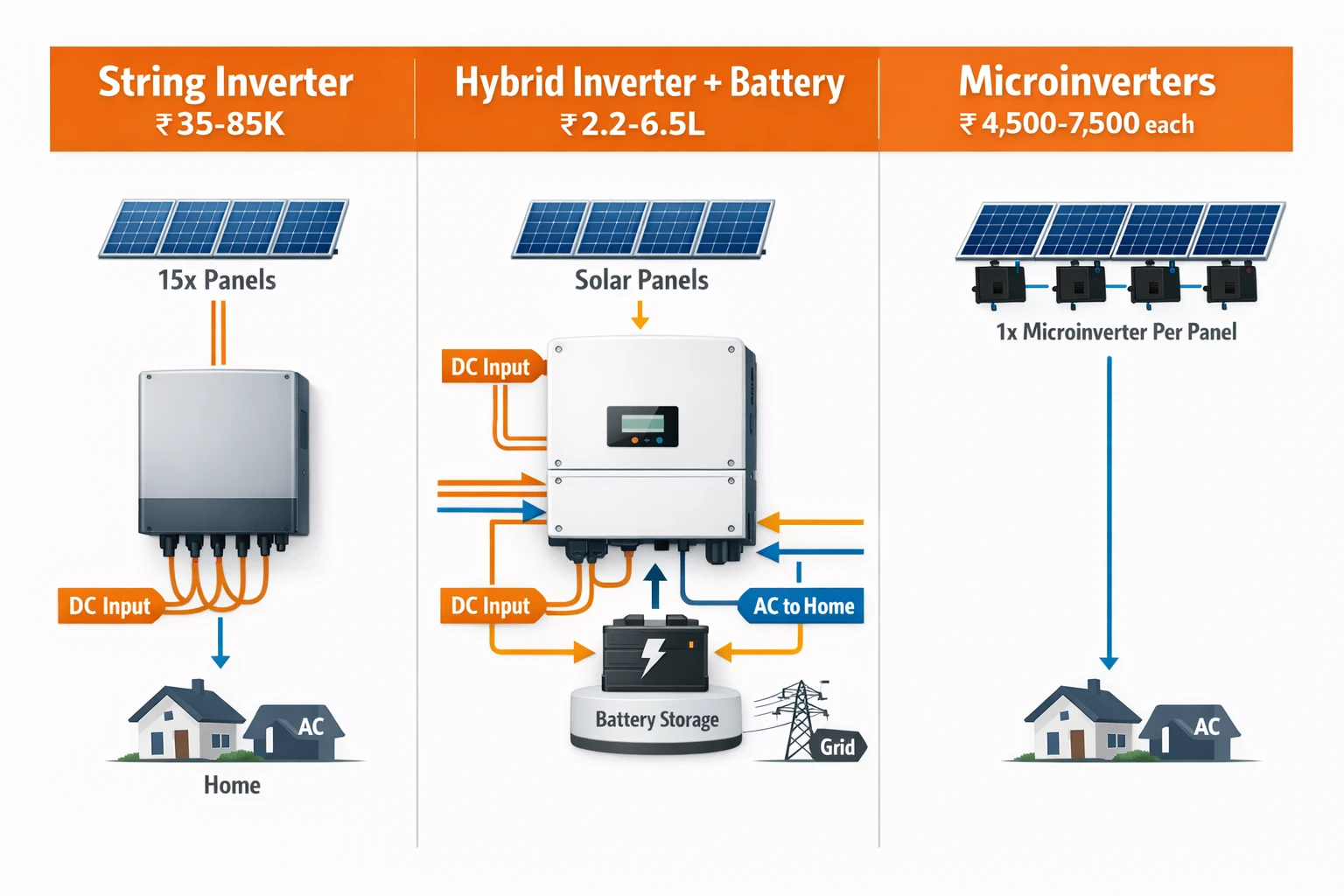
A string inverter is a single centralized unit (typically wall-mounted) that connects to all your solar panels arranged in "strings" (series connections). It is the most common type in India—used in 85% of residential rooftop installations.
How It Works:
- 15-17 panels connected in series form a "string"
- DC power from entire string flows to one central inverter
- Inverter converts all DC to AC in one location
- AC power feeds to your home distribution board
Pricing in India (2026):
- 3kW string inverter: ₹35,000-45,000
- 5kW string inverter: ₹45,000-65,000
- 7kW string inverter: ₹60,000-85,000
- 10kW string inverter: ₹85,000-1,20,000
Top String Inverter Brands in India:
Budget Segment (₹35-50K for 3-5kW):
- Luminous Solar NXT - Most popular Indian brand, 5-year warranty, 97% efficiency
- UTL Gamma Plus - Good value, established after-sales network
- Microtek Solar - Budget-friendly, decent reliability
Mid-Range (₹50-75K for 5-7kW):
- Growatt (Chinese, India assembly) - Excellent efficiency 97.6%, Wi-Fi monitoring, 5-10 year warranty
- Sungrow - High reliability, used in commercial projects, 97.8% efficiency
- Delta (Taiwanese) - Premium build quality, 97.5% efficiency, 5-year warranty
Premium (₹75K-1.2L for 5-10kW):
- Fronius (Austrian) - Industry-leading 98.1% efficiency, 5-year warranty (extendable to 10 years)
- SMA (German) - Gold standard for reliability, 98% efficiency, excellent monitoring
- ABB (Swiss) - Commercial-grade, 97.9% efficiency, robust build
Advantages of String Inverters:
- Lowest upfront cost: ₹35-65K for residential systems vs ₹60K-1.2L for hybrid
- Proven reliability: Decades of field testing, well-understood technology
- Easy maintenance: Single unit to monitor, repair, or replace
- Wide installer familiarity: Every solar technician in India knows string inverters
- Compact installation: One wall-mounted box vs multiple microinverters on roof
Disadvantages of String Inverters:
- No battery backup: Grid-dependent, no power during outages unless you add separate battery system
- Shading sensitivity: If one panel is shaded, entire string performance drops (series circuit limitation)
- Single point of failure: If inverter fails, entire system stops (unlike microinverters where one failure affects only one panel)
- Shorter lifespan than panels: 10-12 year life vs 25-30 year panels (requires replacement)
Best For:
- 90% of Indian homes with uniform rooftops (no shading)
- Grid-connected systems with reliable DISCOM supply
- Budget-conscious buyers (₹35-65K vs ₹80K-1.5L for alternatives)
- Simple installations with all panels facing same direction
Real User Experience (Mr. Ramesh Kumar, Pune): "Installed Growatt 5kW string inverter in 2021. Four years later, still running at 97% efficiency. Monitoring app shows real-time generation. Only issue: When one panel gets bird droppings, generation drops 8-10% until I clean it. But for ₹52,000 cost, excellent value. My friend paid ₹1.1 lakh for hybrid and regrets it—he rarely uses battery feature."
Hybrid Inverters: Solar + Battery Backup Combined
What Is a Hybrid Inverter?
A hybrid inverter combines three functions in one unit: (1) solar DC-to-AC conversion, (2) battery charging/discharging management, and (3) grid interaction for net metering. Think of it as a string inverter + battery inverter + charge controller merged.
How It Works:
- Solar panels generate DC power
- Hybrid inverter decides: send to home (immediate use), charge battery (storage), or export to grid (surplus)
- During grid outage, inverter switches to battery mode automatically
- Seamless transition between solar, battery, and grid power
Pricing in India (2026):
Inverter Only (No Battery):
- 3kW hybrid inverter: ₹55,000-75,000
- 5kW hybrid inverter: ₹75,000-1,05,000
- 7kW hybrid inverter: ₹1,10,000-1,45,000
Complete Hybrid System (Inverter + Battery):
- 3kW with 5kWh lithium battery: ₹2,20,000-2,80,000
- 5kW with 10kWh lithium battery: ₹3,50,000-4,50,000
- 7kW with 15kWh lithium battery: ₹5,00,000-6,50,000
Top Hybrid Inverter Brands in India:
Budget-Mid Range:
- Luminous Solar Hybrid - ₹70K-95K, most popular in India, compatible with various battery types
- UTL Hybrid - ₹65K-90K, good value, established service network
- Microtek Hybrid - ₹60K-85K, budget option, basic features
Premium:
- Growatt SPH Hybrid - ₹85K-1.2L, excellent battery management, Wi-Fi monitoring
- Deye Hybrid (Chinese) - ₹75K-1L, gaining popularity, cost-effective
- SMA Sunny Boy Storage - ₹1.8L-2.5L, premium German engineering, commercial-grade
- Fronius Primo GEN24 - ₹1.5L-2.2L, exceptional efficiency 98%, smart grid features
Advantages of Hybrid Inverters:
- Zero dependency on grid: Full backup during power outages (if battery sized adequately)
- Load shifting capability: Store cheap solar electricity, use during expensive evening peak tariff hours
- Future-proof: Can start without battery, add later when prices drop or need arises
- Smart energy management: AI-based charging/discharging based on weather forecasts (premium models)
- Seamless switching: Milliseconds transfer from grid to battery (no UPS needed for computers)
Disadvantages of Hybrid Inverters:
- High upfront cost: ₹2.2L-6.5L for complete system vs ₹1.6L-3.4L for string inverter setup
- Battery replacement: Lithium batteries last 7-10 years, replacement costs ₹1.5L-3.5L
- Complexity: More components = more failure points, harder to diagnose issues
- Installer expertise required: Not all solar technicians understand hybrid systems (limited service availability in tier 2/3 cities)
- Lower ROI: Extra ₹1-2 lakh investment rarely justified by battery savings unless grid is unreliable
Best For:
- Areas with frequent power cuts (6+ hours daily outages)
- Off-grid locations (farmhouses, remote areas)
- Businesses requiring 24/7 uptime (clinics, data centers, cold storage)
- Homes with time-of-day tariffs (store solar during day, use during expensive evening hours)
- Eco-conscious buyers wanting 100% solar independence
When Hybrid Is NOT Worth It:
- Reliable grid areas (Mumbai, Delhi, Bengaluru with <1 hour daily outage)
- Budget-constrained (₹1-2 lakh extra rarely pays back through battery use)
- Net metering available (grid acts as free "virtual battery")
Real User Experience (Dr. Meena Patel, Ahmedabad): "We installed 5kW hybrid with 10kWh lithium battery in 2022 for ₹4.2 lakh total. Gujarat has good grid supply, so we use battery maybe 10-15 days yearly during scheduled maintenance outages. In hindsight, a string inverter + ₹45K diesel genset would have been smarter. The battery sits idle 95% of the time. Only advantage: feels good being grid-independent, but financially, poor decision."
Microinverters: The Premium Solution for Shading Problems
What Is a Microinverter?
Instead of one central inverter, microinverters are small inverters (size of a hardcover book) attached to EACH individual solar panel. Each panel has its own dedicated inverter performing DC-to-AC conversion right on the roof.
How It Works:
- Each panel (300W) has a microinverter (300-400W capacity) bolted underneath
- DC-to-AC conversion happens at panel level
- AC power from all panels combines and feeds to home distribution board
- Each panel operates independently
Pricing in India (2026):
- Single microinverter (300-400W): ₹4,500-7,000
- 3kW system (10 panels × microinverters): ₹80,000-1,10,000
- 5kW system (17 panels × microinverters): ₹1,20,000-1,65,000
- 7kW system (23 panels × microinverters): ₹1,60,000-2,20,000
Top Microinverter Brands in India:
Premium (Global Brands):
- Enphase (USA) - Industry leader, 96.5% efficiency, 25-year warranty, ₹6,500-7,500 per unit
- AP Systems (Chinese) - Good alternative, 96% efficiency, 10-year warranty, ₹5,500-6,500 per unit
- SolarEdge Power Optimizers (Israeli) - Technically "DC optimizers" not microinverters, but similar benefits, ₹3,500-5,000 per unit + central inverter
Note: True microinverter adoption in India is <5% of residential market due to high costs. Mostly used in premium villas with complex roof geometry.
Advantages of Microinverters:
- Shading immunity: One shaded panel affects only itself, not entire string (huge advantage for complex rooftops)
- Panel-level monitoring: Know exactly which panel underperforms, easier troubleshooting
- Flexible design: Panels can face different directions (east-west mixed), different tilt angles
- No single point of failure: If one microinverter fails, other 16 panels keep working (vs string inverter failure killing entire system)
- Longer warranty: Enphase offers 25-year warranty vs 5-10 years for string inverters
- Safer: No high-voltage DC wiring on roof (fire hazard reduced)
Disadvantages of Microinverters:
- Extremely expensive: ₹80K-2.2L vs ₹35K-85K for equivalent string inverter (2-3x cost)
- More failure points: 17 microinverters = 17 potential failures vs 1 string inverter
- Roof access required for repairs: Failed microinverter needs roof climb, panel removal (vs ground-level string inverter access)
- Heat exposure: Mounted under panels in 70-80°C environment, potentially shorter lifespan despite warranty
- Limited installer expertise in India: Few technicians trained on microinverter troubleshooting
Best For:
- Homes with unavoidable shading (trees, chimneys, water tanks blocking portions of roof)
- Multi-directional rooftops (L-shaped, U-shaped buildings with panels facing east + west + south)
- Premium installations where budget is not a constraint
- Future expandability (add panels one-by-one easily without inverter capacity limits)
When Microinverters Are Overkill:
- Uniform flat rooftops with no shading (90% of Indian homes)
- Budget installations (₹1.2L extra buys you NOTHING for standard roofs)
- String inverters + careful panel placement solves 95% of shading issues at 1/3rd the cost
Real User Experience (Mr. Aditya Verma, Bengaluru villa): "My 7kW system has panels on three roof sections facing different directions due to architecture. String inverter would perform poorly. Installed Enphase microinverters for ₹1.85 lakh. Monitoring shows each panel individually—fascinating but expensive. Generation is 12-15% higher than neighbor's string system due to shading optimization. Worth it for complex roofs, waste of money for simple roofs."
Head-to-Head Comparison: Which Type Suits Your Home?
Let's compare all three for a typical 5kW Indian residential system:
String Inverter (Growatt 5kW):
- Cost: ₹52,000
- Efficiency: 97.6%
- Warranty: 5 years
- Installation: 4-6 hours
- Best for: Standard rooftops, budget-conscious, grid-connected
- Lifespan: 10-12 years
- Maintenance: ₹1,000-2,000/year (basic inspection)
Hybrid Inverter (Luminous 5kW + 10kWh battery):
- Cost: ₹3,80,000 (₹85K inverter + ₹2,95K battery)
- Efficiency: 96% (solar) + 92% (battery round-trip)
- Warranty: 5 years inverter, 7 years battery
- Installation: 8-12 hours (complex wiring)
- Best for: Frequent power cuts, off-grid, energy independence
- Lifespan: 10 years inverter, 7-10 years battery
- Maintenance: ₹2,500-4,000/year (battery monitoring)
Microinverters (Enphase IQ7+ × 17 units):
- Cost: ₹1,27,500 (17 × ₹7,500)
- Efficiency: 96.5%
- Warranty: 25 years
- Installation: 6-8 hours (panel-by-panel setup)
- Best for: Shaded roofs, multi-directional, premium villas
- Lifespan: 15-20 years (claimed 25, realistically 15-18)
- Maintenance: ₹1,500-2,500/year (multiple unit inspections)
Decision Matrix:
Choose String If:
- Uniform flat rooftop, minimal shading
- Budget ₹1.5-3.5 lakh for complete system
- Reliable grid with net metering
- You are okay with 10-12 year replacement cycle
Choose Hybrid If:
- Daily power cuts exceed 4-6 hours
- Off-grid or unreliable DISCOM
- Budget ₹3.5-6.5 lakh for complete system
- Future battery prices concern you (lock in now)
Choose Microinverter If:
- Complex roof (L-shape, multiple directions)
- Unavoidable shading (trees, buildings, tanks)
- Premium budget ₹3-5 lakh for system
- You value panel-level monitoring and warranties
For 90% of Indian homes: String inverter wins on cost-benefit. Hybrid and microinverters are niche solutions for specific problems.
Top 10 Solar Inverter Brands in India 2026
Ranked by market share, reliability, and after-sales service in India:
1. Luminous (Indian Brand)
- Market share: 28% (highest in residential segment)
- Models: NXT series (string), Solar Hybrid series
- Price range: ₹35K-1.2L
- Strengths: Pan-India service, 1,500+ service centers, budget-friendly
- Weakness: Efficiency lower than imports (96-97% vs 98%+)
2. Growatt (Chinese, India Assembly)
- Market share: 15%
- Models: MIN series (string), SPH series (hybrid)
- Price range: ₹45K-1.3L
- Strengths: Excellent efficiency (97.6%), Wi-Fi monitoring, competitive pricing
- Weakness: Service network weaker in tier 2/3 cities
3. Delta (Taiwanese)
- Market share: 12%
- Models: M series, RPI H series (hybrid)
- Price range: ₹55K-1.5L
- Strengths: Industrial-grade reliability, used in large projects
- Weakness: Higher pricing for residential segment
4. Sungrow (Chinese)
- Market share: 10%
- Models: SG series (string), SH-RS series (hybrid)
- Price range: ₹50K-1.4L
- Strengths: Proven in utility-scale, robust build
- Weakness: Limited residential dealer network in India
5. Fronius (Austrian)
- Market share: 6%
- Models: Primo, Symo series (string), GEN24 (hybrid)
- Price range: ₹85K-2.5L
- Strengths: Industry-leading efficiency (98.1%), 10-year extendable warranty
- Weakness: Premium pricing, limited budget options
6. SMA (German)
- Market share: 5%
- Models: Sunny Boy series
- Price range: ₹95K-2.8L
- Strengths: Gold standard reliability, used by professionals
- Weakness: Very expensive for Indian residential market
7. Enphase (USA - Microinverters)
- Market share: 2% (niche)
- Models: IQ7, IQ8 series
- Price range: ₹6,500-7,500 per unit
- Strengths: 25-year warranty, panel-level optimization
- Weakness: Extremely expensive, ₹1.2L+ for 5kW system
8. ABB (Swiss)
- Market share: 4%
- Models: UNO, TRIO series
- Price range: ₹70K-2L
- Strengths: Commercial-grade durability
- Weakness: Overkill for residential, costly
9. Microtek (Indian Brand)
- Market share: 8%
- Models: M-SUN series
- Price range: ₹30K-85K
- Strengths: Budget-friendly, established brand
- Weakness: Lower efficiency (95-96%), basic features
10. Deye/Sofar (Chinese)
- Market share: 3% (growing fast)
- Models: Hybrid SUN-5K-SG04LP3
- Price range: ₹60K-1L
- Strengths: Excellent value hybrid inverters, good specs
- Weakness: New to India, unproven long-term reliability
Recommendation by Budget:
- Budget (<₹50K): Luminous NXT or Microtek M-SUN
- Mid-range (₹50-80K): Growatt MIN or Delta M-series
- Premium (₹80K+): Fronius Primo or SMA Sunny Boy
Capacity Sizing: 3kW, 5kW, or 7kW Inverter?
Inverter capacity must match your solar panel array size. Undersizing or oversizing both cause problems.
Simple Rule: Inverter capacity = 80-100% of solar panel array capacity
Example:
- 5kW solar array (17 × 300W panels) → Choose 5kW inverter
- 3kW solar array (10 × 300W panels) → Choose 3kW inverter
Why Not Oversize? (6kW inverter for 5kW panels)
- Wasted money (₹10K-15K extra cost)
- Inverter operates below optimal efficiency range
- Higher standby power consumption
Why Not Undersize? (4kW inverter for 5kW panels)
- Peak generation clipped (you lose 1kW during noon hours)
- Annual generation loss 8-12%
- Inverter runs at 100% constantly (faster wear, shorter lifespan)
Indian Solar Installer Trick to Avoid:
Some installers recommend 6kW inverter for 5kW panels claiming "future expansion capability." This is usually a markup scam. If you genuinely plan to add panels later, fine. Otherwise, match inverter to current panel capacity.
Correct Sizing Examples:
3kW System:
- 10 × 300W panels = 3,000W
- Choose: 3kW inverter
- Brands: Luminous 3kW NXT (₹38K), Growatt 3kW MIN (₹42K)
5kW System:
- 17 × 300W panels = 5,100W
- Choose: 5kW inverter (handles slight oversizing fine)
- Brands: Growatt 5kW MIN (₹52K), Delta 5kW M-series (₹62K)
7kW System:
- 23 × 330W panels = 7,590W
- Choose: 7.5kW or 8kW inverter
- Brands: Sungrow 8kW (₹78K), Fronius 7.5kW Primo (₹95K)
Warranty, Efficiency & Lifespan Comparison
Warranty Terms (2026 Indian Market):
String Inverters:
- Budget brands: 5 years standard
- Premium brands: 5 years standard + 5-10 years optional extension (₹8K-15K)
- What's covered: Manufacturing defects, component failures
- What's NOT covered: Damage from improper installation, lightning, grid faults, physical damage
Hybrid Inverters:
- Inverter unit: 5 years standard
- Battery: 5-7 years (lithium), 3-5 years (lead-acid)
- Combined warranty sometimes offered (check fine print)
Microinverters:
- Enphase: 25 years (industry-leading)
- AP Systems: 10 years standard
- Covers failure but NOT roof access labor costs for replacement
Efficiency Ratings:
String Inverters:
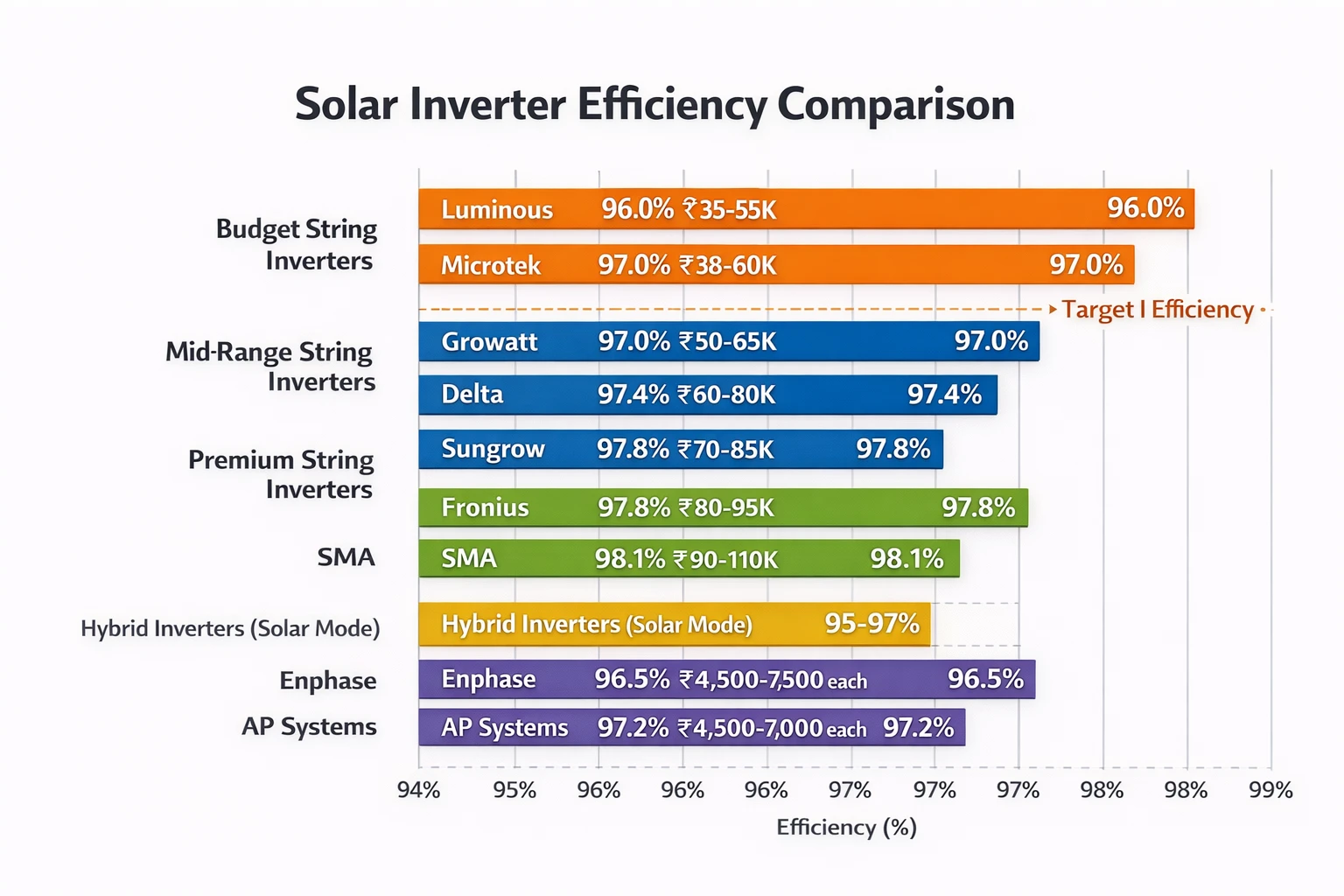
- Budget (Luminous, Microtek): 96-97%
- Mid-range (Growatt, Delta): 97-97.8%
- Premium (Fronius, SMA): 97.8-98.1%
Hybrid Inverters:
- Solar mode: 95-97% (slightly lower due to additional components)
- Battery charging: 92-95%
- Battery discharging: 90-94%
- Round-trip efficiency (solar→battery→home): 85-90%
Microinverters:
- Enphase IQ7+/IQ8: 96.5-97.2%
- AP Systems: 96-96.5%
- Slightly lower than top string inverters but made up by shading optimization
Real Lifespan (Field Data from India):
String Inverters:
- Rated: 10-15 years
- Realistic in Indian heat: 10-12 years
- Failures increase after Year 8
Hybrid Inverters:
- Inverter unit: 10-12 years
- Lithium battery: 7-10 years (80% capacity remaining)
- Lead-acid battery: 4-6 years (not recommended)
Microinverters:
- Rated: 20-25 years
- Realistic in Indian roof heat (70-80°C): 15-18 years
- Warranty covers replacement but roof access labor adds cost
Cost of Ownership (15-Year Period):
String Inverter:
- Initial: ₹52,000 (5kW Growatt)
- Replacement Year 12: ₹60,000 (inflation-adjusted)
- Total: ₹1,12,000
Hybrid Inverter:
- Initial: ₹3,80,000 (5kW + battery)
- Battery replacement Year 8: ₹3,20,000
- Inverter replacement Year 12: ₹1,00,000
- Total: ₹8,00,000
Microinverters:
- Initial: ₹1,27,500 (Enphase × 17)
- Replacements Year 12 (3 failures @ 20%): ₹22,500
- Total: ₹1,50,000
String inverters win on 15-year cost for standard installations.
Installation & Maintenance Costs
Installation Labor Costs (India 2026):
String Inverter:
- Installation time: 4-6 hours
- Labor charges: Included in system cost usually
- Complexity: Low (wall mount, simple wiring)
Hybrid Inverter:
- Installation time: 8-12 hours
- Labor charges: ₹5,000-12,000 extra (battery integration)
- Complexity: Medium-high (DC/AC/battery wiring, programming)
Microinverters:
- Installation time: 6-10 hours
- Labor charges: ₹8,000-15,000 (panel-by-panel attachment)
- Complexity: Medium (repetitive but tedious, AC wiring safer)
Annual Maintenance:
String Inverter:
- Visual inspection: Free (homeowner can do)
- Professional checkup: ₹1,000-2,000 annually
- Cleaning/tightening: Minimal
- Software updates: Remote (free on Wi-Fi models)
Hybrid Inverter:
- Inverter + battery inspection: ₹2,500-4,000 annually
- Battery health monitoring: Critical (prevents unexpected failure)
- Firmware updates: Required for optimal battery management
Microinverters:
- Multiple unit inspection: ₹1,500-3,000 annually
- Monitoring system checks: Usually remote
- Replacement labor: ₹1,500-3,000 per unit (roof access needed)
Common Failures & Repair Costs:
String Inverter:
- Capacitor failure (Year 6-8): ₹3,000-6,000 repair
- Display malfunction: ₹2,000-4,000
- Fan replacement: ₹1,500-2,500
Hybrid Inverter:
- Battery BMS failure: ₹8,000-15,000
- Same string inverter issues: ₹3,000-6,000
Microinverters:
- Unit replacement (under warranty): Free (but ₹2,000-3,000 labor)
- Out-of-warranty: ₹4,500-7,000 per unit
When Each Inverter Type Makes Sense
Choose String Inverter When:
- Your rooftop is flat, uniform, facing one direction (90% of Indian homes)
- No shading from trees, buildings, water tanks, chimneys
- You have reliable grid with net metering (Mumbai, Delhi, Bengaluru, Chennai)
- Budget is ₹1.5-3.5 lakh for complete solar system
- You want proven, simple technology with wide service availability
- Replacement every 10-12 years is acceptable
Choose Hybrid Inverter When:
- You experience 4+ hours daily power outages (rural areas, tier 2/3 cities)
- DISCOM supply is unreliable (frequent tripping, voltage fluctuations)
- You run critical loads requiring 24/7 uptime (medical equipment, business)
- You want 100% energy independence (environmental/lifestyle choice)
- Your state has time-of-day tariffs (charge battery during cheap hours, use during expensive)
- Budget allows ₹3.5-6.5 lakh investment
- You accept 7-10 year battery replacement cost
Choose Microinverters When:
- Your roof has unavoidable shading (large trees, neighboring buildings, chimneys, water tanks)
- Complex multi-directional roof (L-shaped, U-shaped architecture with panels facing east + west + south)
- You value panel-level monitoring and individual performance tracking
- Premium budget ₹3-5 lakh for system (₹1.2L+ for inverters alone)
- You want maximum warranty coverage (25 years)
- Future expansion planned (easy to add panels one-by-one)
Common Mistakes Indians Make When Choosing Inverters
Mistake 1: Oversizing "for future expansion"
- Installers push 6kW inverter for 5kW panels claiming "you might add more panels"
- Reality: 90% never expand
- You waste ₹10K-15K on unused capacity
- Fix: Size inverter to current panel array, upgrade inverter IF you expand later
Mistake 2: Choosing hybrid when not needed
- Salesmen scare you with "power cuts" to upsell ₹3.8L hybrid vs ₹2.2L string setup
- Mumbai/Bengaluru/Delhi have <1 hour daily outages—hybrid battery sits idle
- Fix: Hybrid ONLY makes sense if power cuts exceed 4 hours daily or off-grid
Mistake 3: Ignoring efficiency for warranty
- "This inverter has 10-year warranty!" (but 94% efficiency vs 98% competitor)
- 4% efficiency loss on 5kW = 200W continuous waste = 730 units/year = ₹5,110 annual loss
- Over 10 years, you lose ₹51,100—more than the inverter cost
- Fix: Prioritize efficiency first (97%+ minimum), then warranty
Mistake 4: Brand loyalty without research
- "I trust Luminous for home inverters, so I'll get Luminous solar inverter"
- Home UPS inverters ≠ solar inverters (different technology)
- Luminous solar is fine but Growatt/Delta often better specs at similar pricing
- Fix: Compare 3-4 brands specifically for solar, ignore home UPS reputation
Mistake 5: Cheapest quote wins
- Installer A quotes ₹2.4L with Fronius inverter (₹65K)
- Installer B quotes ₹2.1L with unknown Chinese inverter (₹28K)
- You save ₹30,000 upfront but lose ₹40,000+ in efficiency over 10 years
- Fix: Compare inverter brand/model across quotes, not just total price
Mistake 6: No monitoring system
- Budget inverters (Microtek, UTL) lack Wi-Fi monitoring
- You discover underperformance 6 months later when bills don't drop as expected
- Fix: Insist on Wi-Fi/app-based monitoring (Growatt, Delta, Fronius include this)
Mistake 7: Installing inverter in direct sunlight
- Inverter mounted on sun-exposed exterior wall
- Internal temp reaches 70-80°C, efficiency drops, lifespan cut 30-40%
- Fix: Install in shaded area, garage, covered balcony, or add sunshade
Conclusion & Buying Recommendations
After comparing all three inverter types across pricing, efficiency, reliability, and suitability for Indian conditions, here are the clear recommendations:
For 85% of Indian Homes: String Inverter
If you have a standard flat rooftop with minimal shading and reliable grid connection, a quality string inverter is the smart choice:
- Best Budget Option: Luminous NXT 5kW (₹45K) - Proven reliability, pan-India service
- Best Value Option: Growatt MIN 5kW (₹52K) - Excellent 97.6% efficiency, Wi-Fi monitoring
- Best Premium Option: Fronius Primo 5kW (₹85K) - Industry-leading 98.1% efficiency, 10-year warranty
For Frequent Power Cuts: Hybrid Inverter
If you experience 4+ hours daily outages or want energy independence:
- Best Value: Growatt SPH 5kW + 10kWh lithium (₹3.6L) - Good specs, competitive pricing
- Best Premium: Fronius GEN24 5kW + battery (₹5.2L) - Top efficiency, smart features
For Shading/Complex Roofs: Microinverters
If unavoidable shading or multi-directional roof makes string inverters inefficient:
- Only Real Choice: Enphase IQ7+/IQ8 (₹1.3L for 5kW) - 25-year warranty, proven technology
Final Verdict:
Your inverter is as important as your solar panels—sometimes more important. A ₹52,000 investment in a quality Growatt or Delta string inverter will serve you reliably for 10-12 years with 97-98% efficiency. Skimping to save ₹8,000-12,000 on a budget inverter costs you ₹40,000-50,000 in wasted electricity over its lifespan.
For the vast majority of Indian homeowners with standard rooftops and grid connection, string inverters from Growatt, Delta, or Luminous offer the best balance of cost, efficiency, and reliability. Hybrid and microinverters are premium solutions for specific problems—don't pay for capabilities you don't need.
Your Action Plan:
- Assess your roof (shading, direction, complexity)
- Check grid reliability (power cut hours daily)
- Determine budget (string ₹1.6-3.4L, hybrid ₹3.5-6.5L, micro ₹3-5L for complete systems)
- Get 3 quotes with specific inverter brands/models
- Compare efficiency ratings (97%+ target)
- Verify warranty terms and local service availability
- Choose string unless you have specific reasons for hybrid/micro
The right inverter maximizes your solar ROI for the next decade. Choose wisely.
FREQUENTLY ASKED QUESTIONS (FAQ SCHEMA)
Q1: Which is better for home: string inverter or hybrid inverter in India?
A: String inverters are better for 90% of Indian homes with reliable grid connection. They cost ₹35-65K (3-5kW) versus ₹2.2-4.5L for hybrid systems. String inverters deliver 97-98% efficiency with simple maintenance and work perfectly with net metering. Choose hybrid only if you experience 4+ hours daily power outages or want complete energy independence. For Mumbai, Delhi, Bengaluru, Chennai with good DISCOM supply, string inverters from Growatt (₹52K), Delta (₹62K), or Luminous (₹45K) offer best value. Hybrid's ₹1-2 lakh premium rarely pays back through battery usage in reliable grid areas.
Q2: What is the best solar inverter brand in India 2026?
A: Top 5 solar inverter brands in India 2026: (1) Growatt - Best value, 97.6% efficiency, ₹45-65K for 3-5kW, excellent Wi-Fi monitoring, 5-year warranty. (2) Luminous - Highest market share, 1,500+ service centers, ₹35-55K budget-friendly. (3) Delta - Industrial-grade reliability, 97.5% efficiency, ₹55-75K. (4) Fronius - Premium choice, 98.1% efficiency, 10-year warranty, ₹85K-1.2L. (5) Sungrow - Proven utility-scale quality, 97.8% efficiency, ₹50-80K. Budget pick: Luminous NXT. Best value: Growatt MIN series. Premium pick: Fronius Primo. All are BIS-certified and compatible with Indian grid specifications.
Q3: How long does a solar inverter last in India?
A: Solar inverters last 10-12 years in Indian climate conditions. String inverters have rated lifespan of 10-15 years but realistic field performance in Indian heat (40-48°C ambient) shows 10-12 years before efficiency drops or failures increase. Premium brands (Fronius, SMA) may reach 12-15 years. Microinverters claim 20-25 years but realistic Indian experience suggests 15-18 years. Hybrid inverters last 10-12 years but batteries need replacement in 7-10 years (lithium) or 4-6 years (lead-acid). Budget for inverter replacement when calculating 25-year solar ROI—panels last 25-30 years but inverters need replacement 2-3 times over panel lifetime.
Q4: What is the difference between string inverter and microinverter?
A: String inverters are single centralized units (₹35-85K) converting DC from all panels to AC in one location. All panels connect in series strings to one inverter. Advantage: Low cost, proven technology, easy maintenance. Disadvantage: Shading one panel reduces entire string performance. Microinverters are small units (₹4,500-7,500 each) attached to individual panels, converting DC-AC at panel level. Each panel operates independently. Advantage: Shading immunity, panel-level monitoring, no single point of failure. Disadvantage: Very expensive (₹1.2-2.2L for 5kW), multiple failure points, roof access needed for repairs. String wins for standard roofs. Microinverters only for complex shaded rooftops.
Q5: Can I use a normal inverter for solar panels in India?
A: No, you cannot use regular home UPS inverters for solar panels. Solar inverters perform specialized functions: (1) MPPT (Maximum Power Point Tracking) to extract maximum power from varying sunlight conditions, (2) Grid synchronization for net metering (matching voltage, frequency, phase to DISCOM grid), (3) Anti-islanding protection (automatically disconnecting during grid outages for worker safety). Home UPS inverters lack these capabilities and are designed for battery charging, not solar panel management. Using wrong inverter voids PM Surya Ghar subsidy eligibility, prevents net metering approval, and wastes 20-30% of solar generation. Only use BIS-certified solar inverters from approved brands (Growatt, Luminous, Delta, Fronius, Sungrow).


