

You open your electricity bill for February 2026. The amount staring back at you: ₹6,247. Your neighbor in the identical 3 BHK apartment next door? His bill reads ₹521. The only difference between your homes is visible on his rooftop—those sleek black solar panels arranged in neat rows. A 5kW solar system.
For middle-class Indian families in Mumbai, Delhi, Bengaluru, and Chennai, the 5kW solar system has become the gold standard. It is not too small to make a meaningful dent in your electricity bills, and not so large that it becomes unaffordable. According to 2026 MNRE data, 37% of all residential solar installations in India are 5kW systems—making it the single most popular capacity choice.
But before you call a solar installer, you need concrete answers: What is the actual cost of a 5kW solar system in 2026? How much subsidy can I claim? Will it really save me ₹5,000-8,000 every month? How many years until I recover my investment? This calculator-style guide provides exact numbers, real examples from Indian cities, and transparent ROI calculations to help you make an informed decision.
What Is a 5kW Solar System? (Daily Generation Explained)
A 5kW (5 kilowatt) solar system is named for its peak power capacity—the maximum electricity it can generate under ideal sunlight conditions. Think of it like your car's horsepower rating: it represents maximum capability, not constant output.
Daily Electricity Generation in Indian Cities:
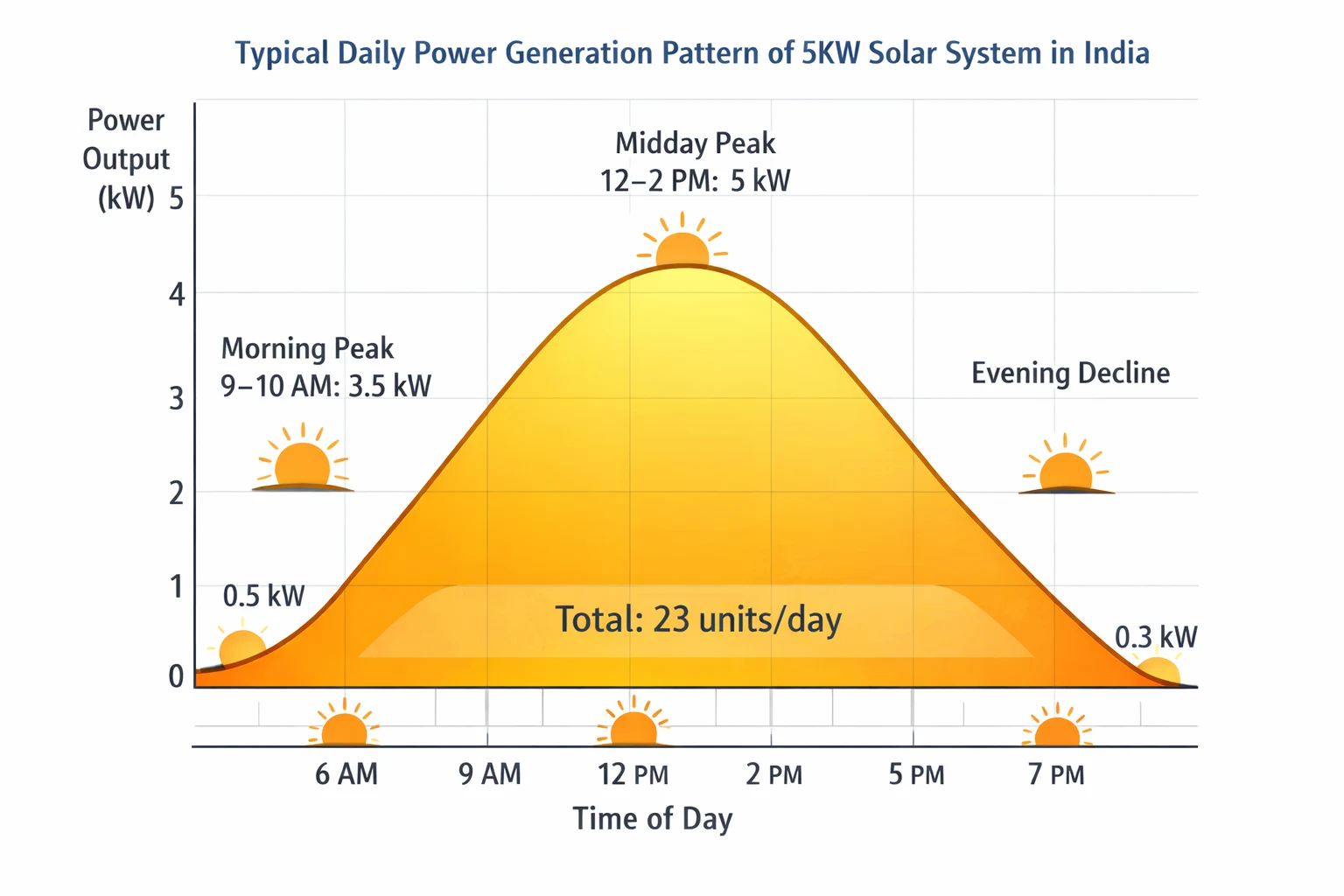
A 5kW system in India typically generates between 20-25 units (kWh) of electricity per day, depending on your location:
- North India (Delhi, Jaipur, Chandigarh): 22-25 units/day with 5.5-6 peak sun hours
- West India (Mumbai, Pune, Ahmedabad): 20-23 units/day with 5-5.5 peak sun hours (monsoon reduces output)
- South India (Bengaluru, Chennai, Hyderabad): 21-24 units/day with 5-5.8 peak sun hours
- East India (Kolkata): 18-21 units/day with 4.5-5 peak sun hours (higher monsoon impact)
This translates to 7,300-9,000 units annually—enough to power most Indian middle-class households completely.
What Can a 5kW System Power?
A 5kW solar system comfortably supports a typical 3-4 BHK home with:
- 2 air conditioners (1-1.5 ton each, running 6-8 hours daily)
- 1 refrigerator (200-300L, running 24/7)
- 1 washing machine (2-3 loads per week)
- 1 water heater or geyser (1-2 kW)
- 8-12 ceiling fans throughout the day
- 2-3 LED TVs
- Kitchen appliances (mixer, microwave for occasional use)
- 1 water pump motor (0.5-1 HP)
- Unlimited phone and laptop charging
The 5kW system can handle an instantaneous load of 4-4.5 kW, meaning you can run most appliances simultaneously without issues.
Complete 5kW Solar System Cost Breakdown 2026
The total cost of a 5kW solar system in India varies based on system type, component quality, and location. Here is the comprehensive breakdown:
On-Grid System (Most Common for Indian Homes): Total cost: ₹2,80,000 - ₹3,60,000 (before subsidy)
Component-wise breakdown:
- Solar panels (17 panels × 300W monocrystalline): ₹1,10,000 - ₹1,40,000
- Solar inverter (5 kW string inverter): ₹40,000 - ₹60,000
- Mounting structure (galvanized steel): ₹22,000 - ₹30,000
- DC/AC cables, MCBs, junction boxes: ₹12,000 - ₹18,000
- Earthing materials and lightning arrestor: ₹6,000 - ₹10,000
- Installation labor and safety equipment: ₹20,000 - ₹35,000
- Net metering setup and DISCOM fees: ₹8,000 - ₹12,000
- Waterproofing (if needed): ₹15,000 - ₹25,000
- Structural assessment: ₹3,000 - ₹5,000
Hybrid System (Solar + Battery Backup): Total cost: ₹4,50,000 - ₹5,50,000
- Includes all on-grid components plus
- Lithium-ion battery (10-12 kWh capacity): ₹1,50,000 - ₹2,00,000
- Hybrid inverter with battery management: ₹60,000 - ₹80,000
Off-Grid System (No Grid Connection): Total cost: ₹5,50,000 - ₹6,50,000
- Larger battery bank (15-20 kWh): ₹2,50,000 - ₹3,50,000
- Pure sine wave off-grid inverter: ₹70,000 - ₹90,000
For most urban Indian homeowners with reliable grid connection, the on-grid system is the most cost-effective choice. You get net metering benefits and avoid expensive battery replacement every 7-10 years.
City-Wise Pricing: Mumbai vs Delhi vs Bengaluru vs Chennai
Installation costs vary by city due to labor rates, transport, and DISCOM-specific requirements:
Mumbai (MSEDCL / BEST / Tata Power / Adani Electricity):
- Total cost: ₹3,20,000 - ₹3,60,000
- Why higher: Coastal area requires PID-resistant panels, stricter DISCOM approvals, higher labor costs
- Average: ₹3,40,000
Delhi NCR (BSES Yamuna / BSES Rajdhani / Tata Power DDL):
- Total cost: ₹2,90,000 - ₹3,30,000
- Moderate pricing with good installer competition
- Average: ₹3,10,000
Bengaluru (BESCOM):
- Total cost: ₹2,80,000 - ₹3,20,000
- Lowest costs due to strong local manufacturing (Vikram Solar, Emmvee Solar)
- Average: ₹3,00,000
Chennai (TANGEDCO):
- Total cost: ₹3,00,000 - ₹3,40,000
- Coastal pricing slightly higher due to humidity-resistant requirements
- Average: ₹3,20,000
Pune (MSEDCL):
- Total cost: ₹2,90,000 - ₹3,30,000
- Moderate climate reduces special requirements
- Average: ₹3,10,000
Ahmedabad (GUVNL / Torrent Power):
- Total cost: ₹2,90,000 - ₹3,40,000
- Gujarat's strong solar infrastructure keeps costs competitive
- Average: ₹3,15,000
These prices are for quality ALMM-compliant monocrystalline panels from reputed brands (Waaree, Tata, Adani, Vikram Solar) with BIS-certified inverters and professional installation.
PM Surya Ghar Subsidy Calculator for 5kW Systems
The PM Surya Ghar Muft Bijli Yojana 2026 offers Central Financial Assistance (CFA) for residential rooftop solar systems:
Subsidy Structure for 5kW:
- First 2 kW: ₹30,000 per kW = ₹60,000
- Next 3 kW (from 2 kW to 5 kW): ₹18,000 per kW = ₹54,000
- Total CFA for 5kW: ₹78,000 (maximum, capped)
Important Note: Whether you install 5 kW, 7 kW, or 10 kW, the maximum central subsidy remains ₹78,000. The subsidy formula is ₹30,000/kW for first 2 kW, then ₹18,000/kW for 2-3 kW additional capacity.
Net Cost After Subsidy:
Taking average city prices:
- Mumbai: ₹3,40,000 - ₹78,000 = ₹2,62,000 net
- Delhi: ₹3,10,000 - ₹78,000 = ₹2,32,000 net
- Bengaluru: ₹3,00,000 - ₹78,000 = ₹2,22,000 net
- Chennai: ₹3,20,000 - ₹78,000 = ₹2,42,000 net
Additional State Subsidies:
Some states offer additional incentives on top of the ₹78,000 central subsidy:
- Gujarat: Up to ₹20,000 additional via GEDA
- Maharashtra: Net metering rebates and expedited approvals (no cash subsidy beyond CFA)
- Rajasthan: 30-40% state subsidy for residential consumers
- Delhi: ₹2,000 per kW (₹10,000 for 5 kW) via Delhi Solar Policy
- Karnataka: Priority net metering, no additional cash subsidy
The subsidy is credited directly to your Aadhaar-linked bank account via DBT within 30 days of commissioning approval.
Monthly Electricity Savings Calculator (Real Examples)
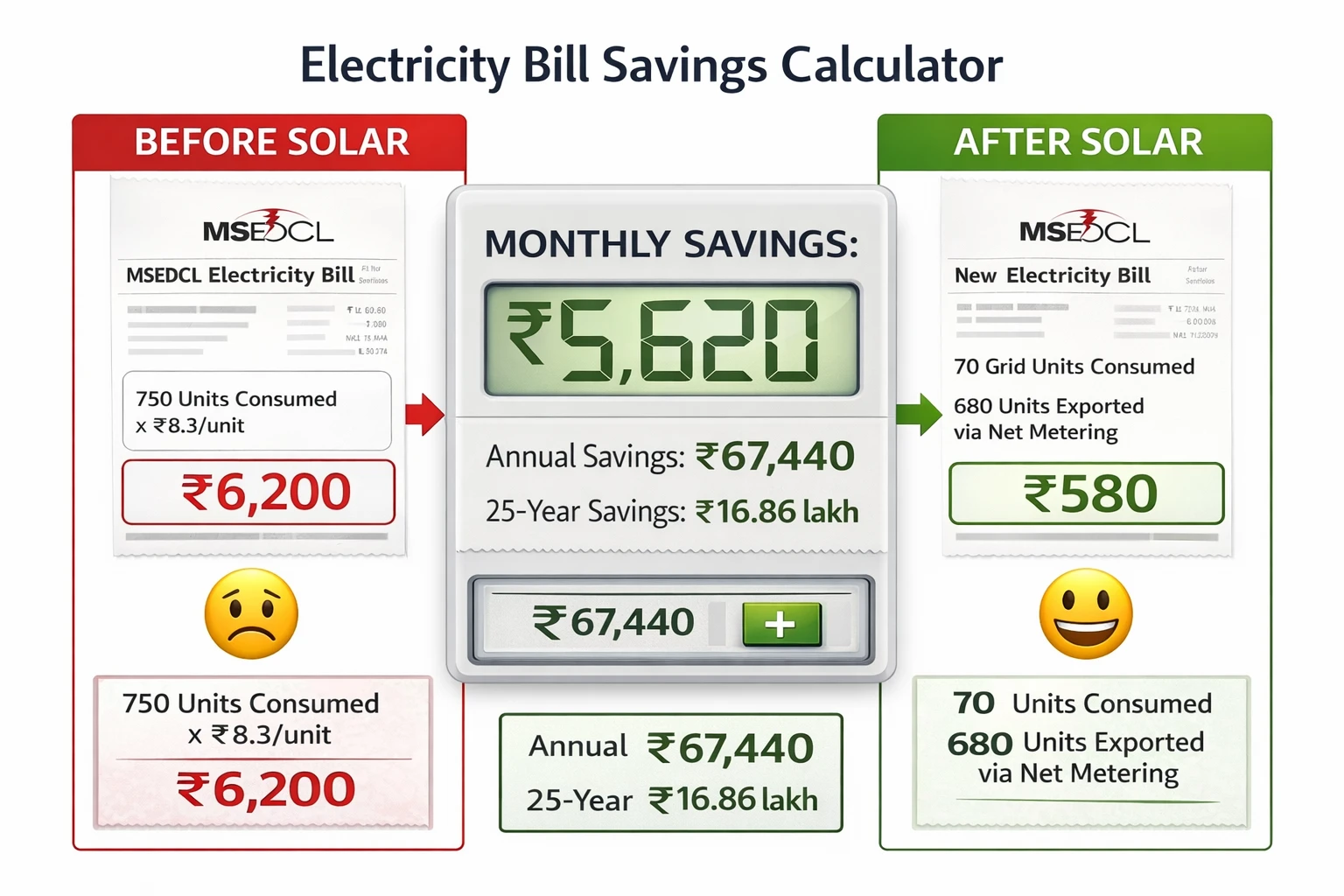
This is where solar investment becomes tangible. Let's calculate monthly savings for different cities using 2026 DISCOM tariffs:
Delhi Example (BSES Rajdhani):
- Daily generation: 23 units
- Monthly generation: 23 × 30 = 690 units
- Current monthly consumption: 750 units
- BSES tariff (slab 401-800 units): ₹7.00/unit
- Previous bill: 750 × ₹7 = ₹5,250
- New bill (with solar): 60 units × ₹4.50 (first slab) = ₹270
- Monthly savings: ₹5,250 - ₹270 = ₹4,980
Mumbai Example (Adani Electricity):
- Daily generation: 21 units (monsoon impact)
- Monthly generation: 21 × 30 = 630 units
- Current monthly consumption: 700 units
- Adani tariff (slab 301-500 units): ₹9.14/unit
- Previous bill: 700 × ₹9.14 = ₹6,398
- New bill (with solar): 70 units × ₹5.37 = ₹376
- Monthly savings: ₹6,398 - ₹376 = ₹6,022
Bengaluru Example (BESCOM):
- Daily generation: 22 units
- Monthly generation: 22 × 30 = 660 units
- Current monthly consumption: 680 units
- BESCOM tariff (slab 501-800 units): ₹7.75/unit
- Previous bill: 680 × ₹7.75 = ₹5,270
- New bill (with solar): 20 units × ₹4.25 = ₹85
- Monthly savings: ₹5,270 - ₹85 = ₹5,185
Chennai Example (TANGEDCO):
- Daily generation: 22 units
- Monthly generation: 22 × 30 = 660 units
- Current monthly consumption: 720 units
- TANGEDCO tariff (slab 501-1000 units): ₹8.00/unit
- Previous bill: 720 × ₹8.00 = ₹5,760
- New bill (with solar): 60 units × ₹3.50 = ₹210
- Monthly savings: ₹5,760 - ₹210 = ₹5,550
Average Monthly Savings Across India: ₹5,000 - ₹8,000
For high-consumption homes (800-1,000 units monthly with AC usage), savings can reach ₹8,000-10,000 per month.
ROI & Payback Period Calculator
Return on Investment (ROI) is the ultimate test of whether solar makes financial sense. Let's calculate using real numbers:
Standard Calculation (Bengaluru Example):
Initial investment: ₹3,00,000 PM Surya Ghar subsidy: -₹78,000 Net investment: ₹2,22,000
Monthly savings: ₹5,185 Annual savings: ₹5,185 × 12 = ₹62,220
Payback period: ₹2,22,000 ÷ ₹62,220 = 3.57 years
25-Year ROI Analysis:
Year 1-3.5: Recovering initial investment (₹2,22,000) Year 4-10: Pure profit = ₹4,35,540 Year 10: Inverter replacement cost = -₹35,000 Year 11-25: Additional profit = ₹9,33,300
Total 25-year savings: ₹15,68,840 (after all costs including inverter replacement)
ROI percentage: (₹15,68,840 ÷ ₹2,22,000) × 100 = 706% return over 25 years
Mumbai Higher ROI (Due to Higher Tariff):
Net investment: ₹2,62,000 Annual savings: ₹6,022 × 12 = ₹72,264 Payback: 3.63 years 25-year total savings: ₹18,06,600
Delhi Moderate ROI:
Net investment: ₹2,32,000 Annual savings: ₹4,980 × 12 = ₹59,760 Payback: 3.88 years 25-year total savings: ₹14,94,000
Key Insight: Even in the "worst case" scenario (Delhi with lowest tariffs), you still earn a 644% return over 25 years—vastly superior to fixed deposits (6-7% annually) or mutual funds (10-12% annually).
What's Included: Component-Wise Cost Analysis
Understanding what you're paying for helps evaluate installer quotes:
Solar Panels (₹1,10,000 - ₹1,40,000):
- 17 monocrystalline panels (300-330W each)
- ALMM-compliant brands: Waaree, Vikram, Goldi Solar, Premier (₹22-26/watt)
- Premium brands: Tata Power Solar, Adani Solar, RenewSys (₹28-32/watt)
- 25-year performance warranty
Solar Inverter (₹40,000 - ₹60,000):
- 5 kW string inverter (on-grid)
- Brands: Luminous, Growatt, Delta, Fronius, SMA
- BIS-certified, 5-10 year warranty
- Converts DC to AC at 97-98% efficiency
Mounting Structure (₹22,000 - ₹30,000):
- Hot-dip galvanized (HDG) steel
- Designed for 150 km/h wind load
- 10-15° tilt angle for Indian latitudes
- 25-year design life
- Ballasted (non-penetrating) option: Add ₹5,000-8,000
Balance of System (₹20,000 - ₹30,000):
- DC cables (6mm² copper): ₹4,000-6,000
- AC cables and conduits: ₹3,000-5,000
- MCBs, DC isolators, AC distribution: ₹5,000-8,000
- Earthing system (earth pit, GI strip, electrode): ₹4,000-6,000
- Lightning arrestor: ₹4,000-5,000
Installation & Commissioning (₹20,000 - ₹35,000):
- Skilled labor (electricians, roofers): ₹12,000-20,000
- Safety equipment (harnesses, helmets, gloves): ₹2,000-3,000
- Technical inspection and testing: ₹3,000-5,000
- DISCOM coordination and paperwork: ₹3,000-7,000
Net Metering (₹8,000 - ₹12,000):
- Bidirectional meter installation by DISCOM
- Meter charges and deposits
- Technical feasibility study
- Net metering agreement processing
5kW vs 3kW vs 7kW: Which Size Do You Need?
Not everyone needs a 5kW system. Here's how to choose:
Choose 3kW if:
- Monthly consumption: 300-450 units
- 2 BHK apartment or small independent house
- Limited rooftop space (250-350 sq ft available)
- Budget constraint (₹1.3-2 lakh after subsidy)
- Daily generation: 12-15 units
- Monthly savings: ₹2,500-4,500
Choose 5kW if:
- Monthly consumption: 500-800 units
- 3-4 BHK home
- 2 ACs running 6-8 hours daily
- Adequate rooftop space (450-550 sq ft)
- Budget: ₹2.2-2.6 lakh after subsidy
- Daily generation: 20-25 units
- Monthly savings: ₹5,000-8,000
Choose 7-10kW if:
- Monthly consumption: 900+ units
- Large villa or joint family home
- 3+ ACs, multiple high-power appliances
- Ample rooftop space (700-1,000 sq ft)
- Budget: ₹3-4.5 lakh after ₹78,000 subsidy
- Daily generation: 30-45 units
- Monthly savings: ₹10,000-15,000
Rule of Thumb: Your solar system should generate 80-100% of your monthly consumption for optimal ROI. Over-sizing wastes money; under-sizing limits savings.
Real Case Study: Pune Family's Solar Journey
Family Profile:
- Location: Kharadi, Pune
- Home: 4 BHK independent house
- Family: Parents + 2 children
- Pre-solar monthly bill: ₹6,180 (average)
- DISCOM: MSEDCL
System Installed (June 2024):
- Capacity: 5 kW on-grid
- Panels: 17 × 300W Waaree monocrystalline
- Inverter: Luminous 5 kW string inverter
- Total cost: ₹2,75,000
- PM Surya Ghar subsidy: ₹78,000
- Net investment: ₹1,97,000
Results (After 18 Months - December 2025):
- Average daily generation: 22 units
- Monthly bill reduced to: ₹490-680 (90% reduction)
- Monthly savings: ₹5,500
- Total savings in 18 months: ₹99,000
- Remaining to recover: ₹98,000
Projected payback: 36 months (3 years) from installation
Homeowner's Feedback (Mr. Ramesh Kumar): "Initially, I was skeptical about the ₹2 lakh investment. But after seeing my first post-solar bill of ₹520, I was convinced. Our summer bills used to touch ₹7,500-8,000 with two ACs running. Now even in peak summer, we don't cross ₹800. The PM Surya Ghar subsidy made it affordable, and the monthly savings feel like a salary increment. Best decision we made for our home."
How to Calculate Your Exact Savings
Follow these steps to calculate your specific ROI:
Step 1: Determine Your Monthly Consumption
- Check last 12 months' electricity bills
- Calculate average monthly units consumed
- Identify peak months (summer AC usage)
Step 2: Calculate System Size Needed
- Divide monthly units by 30 = daily requirement
- Divide daily requirement by 5 (peak sun hours) = system size in kW
- Example: 600 units/month ÷ 30 = 20 units/day ÷ 5 = 4 kW system
- Round up to 5 kW for buffer
Step 3: Get Installer Quotes
- Contact 3-4 DISCOM-empanelled installers
- Ensure ALMM-compliant panels, BIS inverter
- Compare quotes (should be ₹2.8-3.6 lakh for 5 kW)
- Check warranty terms (25-year panel, 5-10 year inverter)
Step 4: Calculate Net Cost
- Subtract ₹78,000 PM Surya Ghar subsidy
- Subtract any state subsidy (if applicable)
- Net cost = Your actual investment
Step 5: Estimate Savings
- Daily generation (20-25 units for 5 kW) × 30 days = monthly generation
- Monthly generation × your DISCOM tariff = monthly savings
- Annual savings = Monthly savings × 12
Step 6: Calculate Payback
- Net investment ÷ Annual savings = Payback years
- Target: 3-5 years is excellent, 5-7 years is good
Step 7: Project 25-Year ROI
- Annual savings × 25 years = Gross savings
- Subtract inverter replacement (Year 10): ₹30,000-40,000
- Subtract maintenance (₹2,000/year × 25 = ₹50,000)
- Net 25-year savings - Net investment = Total profit
Conclusion & Next Steps
A 5kW solar system in India costs ₹2,80,000 - ₹3,60,000 before subsidy, and ₹2,02,000 - ₹2,82,000 after the PM Surya Ghar ₹78,000 subsidy. With monthly savings of ₹5,000-8,000, most families recover their investment in just 3-5 years and enjoy ₹14-18 lakh in total savings over 25 years.
Key Takeaways:
- 5kW systems generate 20-25 units daily (7,300-9,000 units annually)
- Suitable for 3-4 BHK homes consuming 500-800 units monthly
- Payback period: 3-5 years across major Indian cities
- ROI: 600-750% over 25 years
- PM Surya Ghar subsidy of ₹78,000 reduces upfront cost significantly
- Mumbai has highest savings (₹6,000+/month) due to higher tariffs
Your Next Steps:
- Check your last 12 months' electricity bills to calculate average consumption
- Visit pmsuryaghar.gov.in and register to check subsidy eligibility
- Get quotes from 3 DISCOM-empanelled installers in your city
- Verify ALMM compliance and BIS certification
- Calculate your specific ROI using the formulas above
- Schedule technical feasibility inspection by DISCOM
- Choose an installer and begin your solar journey
The numbers don't lie: solar is no longer just environmentally responsible—it's financially smart. With electricity tariffs rising 5-8% annually and solar costs stabilizing, the ROI equation tilts more in your favor every year. The question isn't whether to go solar, but when. For most Indian families, the answer is now.
Calculate your exact savings with Worex Solar's free online calculator and get a customized quote for your home today.
FREQUENTLY ASKED QUESTIONS (FAQ SCHEMA)
Q1: What is the total cost of a 5kW solar system in India in 2026?
A: A 5kW on-grid solar system costs ₹2,80,000 to ₹3,60,000 before subsidy in 2026. After applying the PM Surya Ghar ₹78,000 central subsidy, the net cost ranges from ₹2,02,000 to ₹2,82,000. City-wise variations: Bengaluru (₹2.8-3.2L), Delhi (₹2.9-3.3L), Mumbai (₹3.2-3.6L), Chennai (₹3.0-3.4L). The cost includes ALMM-compliant monocrystalline panels, BIS-certified inverter, mounting structure, installation, and net metering setup.
Q2: How much electricity does a 5kW solar system generate per day in India?
A: A 5kW solar system generates 20-25 units (kWh) of electricity per day on average in India. Daily generation varies by location: North India (Delhi, Jaipur) produces 22-25 units/day with 5.5-6 peak sun hours. South India (Bengaluru, Chennai) generates 21-24 units/day. West India (Mumbai, Pune) produces 20-23 units/day due to monsoon impact. East India (Kolkata) generates 18-21 units/day. Annual generation ranges from 7,300 to 9,000 units depending on location, weather, and maintenance.
Q3: How much can I save monthly on my electricity bill with a 5kW solar system?
A: Monthly electricity bill savings with a 5kW solar system range from ₹5,000 to ₹8,000 across major Indian cities. Actual savings depend on your current consumption and local DISCOM tariff. Examples: Delhi BSES (₹4,980/month savings), Mumbai Adani Electricity (₹6,022/month), Bengaluru BESCOM (₹5,185/month), Chennai TANGEDCO (₹5,550/month). High-consumption homes with AC usage can save ₹8,000-10,000 monthly. Annual savings typically range from ₹60,000 to ₹96,000.
Q4: What is the payback period for a 5kW solar system in India?
A: The payback period for a 5kW solar system in India is typically 3-5 years. Calculation: Net investment (after ₹78,000 subsidy) divided by annual savings. Example: Bengaluru homeowner investing ₹2,22,000 net and saving ₹62,220 annually recovers investment in 3.57 years. Mumbai with higher tariffs achieves payback in 3.63 years despite higher installation cost. Delhi takes approximately 3.88 years. After payback, homeowners enjoy pure profit for the remaining 20-22 years of the system's 25-year lifespan.
Q5: How much PM Surya Ghar subsidy can I get for a 5kW solar system?
A: The PM Surya Ghar Muft Bijli Yojana provides ₹78,000 central subsidy for a 5kW residential solar system. Subsidy calculation: ₹30,000 per kW for the first 2 kW (₹60,000) plus ₹18,000 per kW for the next 3 kW (₹54,000) totaling ₹78,000. This is the maximum central subsidy available regardless of system size—a 7kW or 10kW system also receives only ₹78,000. Some states offer additional subsidies: Gujarat (₹20,000 extra), Delhi (₹10,000), Rajasthan (30-40% state subsidy). The subsidy is credited directly to your Aadhaar-linked bank account within 30 days of commissioning.


