

Solar Panel Cost in Delhi 2026: Complete Price Breakdown for NCR Homeowners
Amit from Dwarka was paying ₹9,200 every month for electricity. His AC ran non-stop during Delhi's brutal summers, and even in winter, his heaters pushed the bill above ₹5,000. In March 2026, he installed a 5 kW rooftop solar system. Today, his monthly bill is just ₹800, and he received ₹78,000 subsidy directly in his bank account.
If you're a Delhi homeowner tired of high electricity bills, you're in the right place. Delhi's scorching summers and rising power tariffs make it one of India's best cities for rooftop solar. This detailed guide covers everything about solar panel costs in Delhi for 2026—equipment prices, installation charges, local installers, government subsidies, and real savings you can expect.
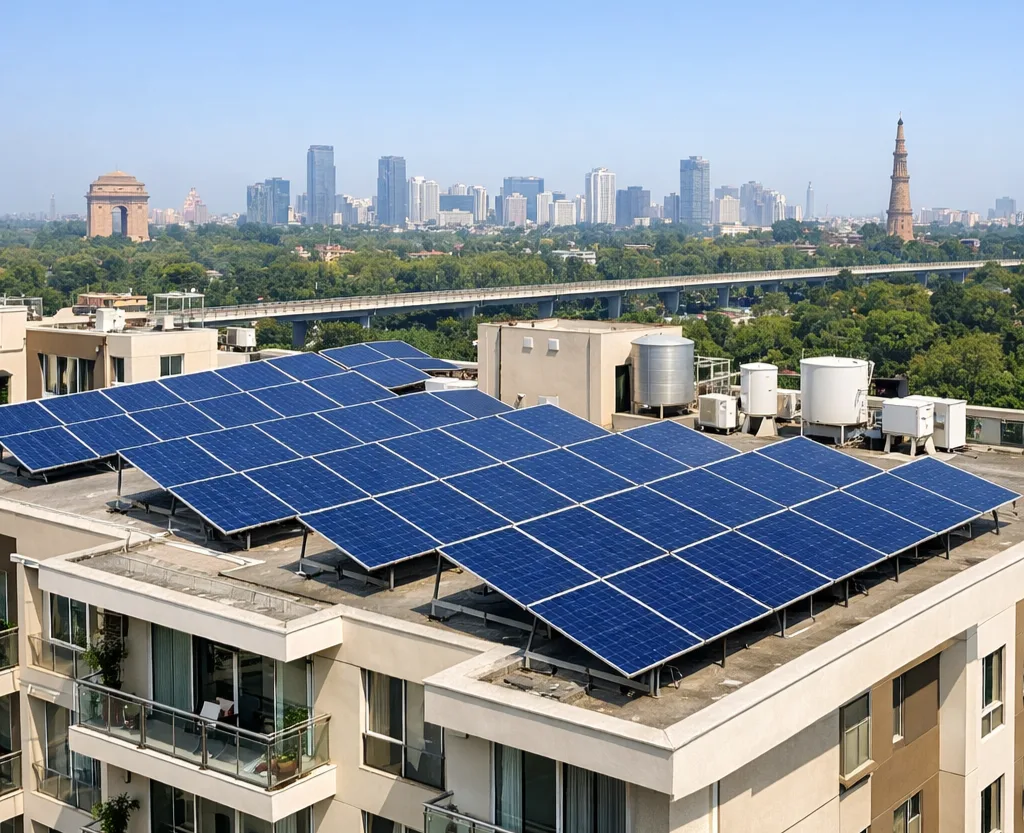
[Image Placeholder 1: Modern Delhi apartment building with rooftop solar panels installed, clear blue sky, urban NCR setting with visible landmarks] Alt text: Rooftop solar panel installation on residential building in Delhi NCR showing complete solar system setup
Why Delhi is Perfect for Solar Panels
Delhi NCR is among the top 5 Indian cities for solar energy potential. Three key factors make solar panels highly profitable here.
Delhi's Electricity Rates and Bill Savings
Delhi's electricity rates have increased significantly. As of February 2026, BSES Rajdhani and BSES Yamuna charge:
Slab 1 (0-200 units): ₹4.50 per unit
Slab 2 (201-400 units): ₹6.50 per unit
Slab 3 (401-800 units): ₹7.50 per unit
Slab 4 (Above 800 units): ₹8.50 per unit
Plus fixed charges of ₹125-₹200 per month.
Most Delhi households with AC consume 400-600 units monthly during summer (April to September). This means bills of ₹6,000-₹9,000 monthly. Even in winter, consumption stays at 250-350 units due to heaters and geysers, leading to ₹3,500-₹5,000 bills.
Tata Power DDL (North and Central Delhi) has similar rates. These high tariffs mean solar panels pay for themselves much faster in Delhi compared to cities with lower electricity costs.
Sunshine Hours in Delhi NCR
Delhi receives excellent sunlight throughout the year:
Summer months (March to September): 8-10 hours of strong sunshine daily
Winter months (October to February): 6-8 hours of good sunshine daily
Annual average: 300+ sunny days
Peak sun hours: 5.5-6 hours daily (this is what matters for solar generation)
Compare this to coastal cities like Mumbai (4.5-5 peak sun hours) or Kolkata (4-4.5 hours). Delhi's clear, dry climate means less cloud cover and better solar performance.
Delhi's pollution does reduce solar output by 5-8% compared to cleaner cities, but regular panel cleaning (monthly during summer, every 2 months in winter) maintains good performance.
Solar Panel Installation Cost in Delhi 2026
Solar panel costs in Delhi are competitive due to high market demand and good availability of quality installers.
Price Per Kilowatt in Delhi
The average cost per kilowatt in Delhi ranges from ₹48,000 to ₹65,000 depending on component quality and installer reputation.
Budget systems: ₹48,000-₹52,000 per kW using Indian mid-range brands like Waaree, Vikram Solar, or Premier Energies with standard string inverters.
Mid-range systems: ₹53,000-₹58,000 per kW using premium Indian brands like Tata Power Solar or Adani Solar with good quality inverters from Growatt or Sungrow.
Premium systems: ₹59,000-₹65,000 per kW using international brands like Longi or Jinko with hybrid inverters or microinverters.
Delhi prices are 3-5% higher than smaller cities but 5-8% lower than Mumbai due to better competition and transportation advantages.
3kW Solar System Cost in Delhi
A 3 kW system is perfect for Delhi homes consuming 300-450 units monthly. This covers most 2-3 BHK apartments without heavy AC usage.
Total cost before subsidy: ₹1,44,000 to ₹1,95,000
PM Surya Ghar subsidy: ₹78,000 (₹60,000 for first 2 kW + ₹18,000 for next 1 kW)
Your net investment: ₹66,000 to ₹1,17,000
What you get: 8-10 solar panels (each 335W-400W), one 3 kW inverter, aluminum mounting structure, all cables and connectors, net metering setup, and installation.
Monthly electricity generation: 360-420 units (12-14 units per day)
Monthly bill savings: ₹2,500-₹3,200 at Delhi's rates
Roof space needed: 250-300 square feet shadow-free area
A typical Delhi household installing 3 kW sees their ₹5,000 monthly bill drop to ₹800-₹1,200 depending on consumption patterns.
5kW Solar System Cost in Delhi
A 5 kW system suits larger Delhi homes with 3-4 BHK, multiple ACs, or high summer consumption above 600 units monthly.
Total cost before subsidy: ₹2,40,000 to ₹3,25,000
PM Surya Ghar subsidy: ₹78,000 (maximum subsidy, same as 3 kW)
Your net investment: ₹1,62,000 to ₹2,47,000
What you get: 13-16 solar panels, one 5 kW inverter, mounting structure for larger installation, complete wiring and safety equipment, net meter, and professional installation.
Monthly electricity generation: 600-700 units (20-23 units per day)
Monthly bill savings: ₹4,200-₹5,500 at Delhi's rates
Roof space needed: 400-500 square feet
Delhi homes with 5 kW systems often see bills drop from ₹8,000-₹9,000 to just ₹500-₹1,000, essentially eliminating electricity costs for 8-9 months of the year.
[Image Placeholder 2: Solar panel installation process on Delhi RCC flat rooftop, installation team working, safety equipment visible, realistic daytime scene] Alt text: Professional solar installation team installing rooftop solar panels on residential building in Delhi NCR
Component-Wise Cost Breakdown for Delhi
Understanding individual component costs helps you negotiate better with installers and spot overpricing.
Solar Panel Prices in Delhi Market
Delhi has excellent availability of all major solar panel brands. Prices as of February 2026:
Indian Budget Brands:
- Vikram Solar: ₹21-₹24 per watt
- Premier Energies: ₹22-₹25 per watt
- Goldi Solar: ₹20-₹23 per watt
These are ALMM-approved and offer 10-year product warranty plus 25-year performance warranty. Good value for money.
Indian Premium Brands:
- Tata Power Solar: ₹27-₹30 per watt
- Adani Solar: ₹26-₹29 per watt
- Waaree (premium series): ₹25-₹28 per watt
Higher efficiency (20-22%), better build quality, and strong after-sales network in Delhi NCR.
International Brands:
- Longi Solar: ₹26-₹29 per watt
- Jinko Solar: ₹25-₹28 per watt
- Canadian Solar: ₹27-₹30 per watt
Best efficiency (21-23%), proven durability, but service network is limited to major Delhi installers only.
For a 3 kW system (using 8 panels of 375W each), panel cost ranges from ₹63,000 (budget) to ₹90,000 (premium).
Most Delhi installers recommend Tata, Waaree, or Adani for the best balance of quality, price, and local service availability.
Solar Inverter Costs in NCR
Inverter is the second most important component. Delhi market prices:
String Inverters (Most Common):
- 3 kW models: ₹30,000-₹42,000 (Luminous, Growatt, Sungrow, Delta)
- 5 kW models: ₹48,000-₹68,000
String inverters work well for Delhi's flat RCC roofs without shading issues. Popular brands in Delhi are Growatt (₹32,000 for 3 kW), Sungrow (₹35,000), and Luminous (₹38,000).
Hybrid Inverters (With Battery Option):
- 3 kW: ₹50,000-₹75,000
- 5 kW: ₹80,000-₹1,25,000
Hybrid inverters let you add battery backup later. Useful in South Delhi areas that occasionally face power cuts. Popular models: Luminous NXG (₹52,000 for 3 kW), Growatt SPH series (₹58,000).
Microinverters (Premium):
- ₹9,000-₹13,000 per panel
- Total for 3 kW: ₹72,000-₹1,04,000
Recommended only if your Delhi roof has partial shading from water tanks, neighboring buildings, or trees. Enphase microinverters are most popular in premium Delhi installations.
Most Delhi households choose standard string inverters to keep costs reasonable while maintaining good performance.
Installation and Labor Charges Delhi
Delhi labor costs are moderate compared to Mumbai but higher than tier-2 cities.
Installation labor: ₹7,000-₹10,000 per kW for standard RCC flat roof. Delhi's typical flat roofs make installation straightforward.
For sloped roofs: ₹10,000-₹14,000 per kW. Some Lutyens Delhi and South Delhi bungalows have sloped roofs requiring more complex mounting.
Net metering charges: ₹8,000-₹15,000 depending on your DISCOM (BSES charges ₹10,000-₹12,000, Tata Power DDL charges ₹8,000-₹10,000). This covers bi-directional meter and official documentation.
Mounting structure: ₹6,000-₹8,000 per kW for aluminum structure (recommended for Delhi's heat), ₹4,500-₹6,500 for GI structure.
Other costs: Earthing kit (₹3,000-₹5,000), AC/DC cables (₹8,000-₹12,000 for 3 kW), junction boxes and connectors (₹4,000-₹6,000).
Total installation and balance-of-system costs for 3 kW: ₹35,000-₹55,000 in Delhi.
Delhi vs NCR: City-Wise Price Comparison
Prices vary slightly across NCR cities due to local competition, transportation, and DISCOM differences.
Delhi vs Gurgaon vs Noida Solar Costs
Delhi (Central, South, West, East Delhi):
- 3 kW system: ₹1,44,000-₹1,95,000
- Cost per kW: ₹48,000-₹65,000
- DISCOMs: BSES Rajdhani, BSES Yamuna, Tata Power DDL
- Net metering process: 15-25 days
Gurgaon (Haryana):
- 3 kW system: ₹1,50,000-₹2,00,000
- Cost per kW: ₹50,000-₹67,000
- DISCOM: Dakshin Haryana Bijli Vitran Nigam (DHBVN)
- Slightly higher due to premium localities and fewer installers
- Net metering: 20-30 days
Noida/Greater Noida (Uttar Pradesh):
- 3 kW system: ₹1,38,000-₹1,85,000
- Cost per kW: ₹46,000-₹62,000
- DISCOM: Paschimanchal Vidyut Vitran Nigam (PVVNL)
- Lower costs due to competitive market
- Net metering: 15-20 days (faster than Delhi)
Faridabad (Haryana):
- 3 kW system: ₹1,42,000-₹1,90,000
- Cost per kW: ₹47,000-₹63,000
- DISCOM: DHBVN
- Mid-range pricing
Ghaziabad (Uttar Pradesh):
- 3 kW system: ₹1,40,000-₹1,88,000
- Cost per kW: ₹47,000-₹63,000
- DISCOM: PVVNL
- Good competition, reasonable prices
Why Prices Vary Across NCR
Transportation costs: Delhi-based installers charge less for Delhi installations. Going to Gurgaon or Noida adds ₹3,000-₹8,000 for transportation and logistics.
Local installer competition: Noida has many local installers competing aggressively. Gurgaon has fewer installers serving premium colonies, hence higher prices.
DISCOM requirements: Each DISCOM has different net metering procedures. BSES in Delhi is well-streamlined. DHBVN in Haryana sometimes requires additional documentation, adding ₹2,000-₹5,000 in processing costs.
Property type: Gurgaon's independent villas often need more complex mounting compared to Delhi's standard apartments, increasing installation costs by 8-12%.
Local regulations: Some Gurgaon RWAs charge ₹5,000-₹10,000 for installation permission. Delhi RWAs generally don't charge or charge minimal amounts.
Overall, Delhi offers the best balance of competitive pricing, installer availability, and streamlined processes.
PM Surya Ghar Subsidy in Delhi 2026
Delhi residents get the same central government subsidy as other Indian cities, with some additional Delhi government benefits.
How Much Subsidy for Delhi Residents?
The PM Surya Ghar Muft Bijli Yojana provides:
For 1 kW system: ₹30,000 subsidy (₹30,000 × 1)
For 2 kW system: ₹60,000 subsidy (₹30,000 × 2)
For 3 kW system: ₹78,000 subsidy (₹60,000 for first 2 kW + ₹18,000 for next 1 kW)
For 4 kW or larger: Maximum ₹78,000 subsidy (no additional subsidy beyond 3 kW)
This subsidy is available to all Delhi residents with:
- Residential electricity connection from BSES or Tata Power DDL
- Property ownership or landlord consent
- ALMM-certified solar panels
- MNRE-empaneled installer
The subsidy is credited directly to your Aadhaar-linked bank account within 30-90 days after DISCOM inspection.
Delhi Government Additional Benefits
While Delhi doesn't offer additional subsidy on top of PM Surya Ghar (unlike Gujarat or Rajasthan), it provides other benefits:
Expedited net metering: Delhi government has instructed BSES and Tata Power DDL to complete net metering within 15 days of application. This is faster than the national average of 30 days.
Simplified documentation: Delhi DISCOMs accept digital property proof. No need for physical notarized documents for most cases.
No rooftop rent for apartments: Unlike some cities where housing societies charge rooftop rent, Delhi's government has mandated free rooftop access for individual flat owners installing solar.
Green tariff benefits: If you generate surplus solar power consistently, some Delhi DISCOMs offer preferential tariff for excess export beyond annual consumption.
Property tax rebate: Delhi Municipal Corporation offers 10% property tax rebate for properties with solar installations (varies by locality, check with your MCD zone).
These additional benefits effectively add ₹8,000-₹15,000 in value over the system's lifetime.
Top Solar Panel Brands Available in Delhi
Delhi market has excellent availability of all major solar brands with good after-sales support.
Premium Brands in Delhi Market
Tata Power Solar: Most trusted brand in Delhi NCR. Their panels cost ₹27-₹30 per watt but come with 25-year performance warranty and excellent service network. Tata has 3 service centers in Delhi (Okhla, Rohini, Dwarka). Response time for issues: 24-48 hours.
Adani Solar: Second most popular premium choice. Pricing ₹26-₹29 per watt. Known for high efficiency (21-22%) and durability in Delhi's heat. Service center in Gurgaon serves entire NCR.
Longi Solar: International brand with strong Delhi presence. Costs ₹26-₹29 per watt. World's largest solar manufacturer with proven quality. Service through authorized Delhi dealers, response time 3-5 days.
Waaree Premium Series: Indian brand with premium line priced at ₹25-₹28 per watt. Manufacturing unit in Surat means easy availability in Delhi. Service centers in Noida and Delhi, 48-72 hour response.
Premium brands make sense if you're planning a 25+ year ownership, want maximum efficiency from limited roof space, or prefer established service networks.
Budget-Friendly Options for Delhi
Vikram Solar: Excellent value at ₹21-₹24 per watt. ALMM-approved, good performance in Delhi's climate. Service through network of Delhi installers. Popular in East and North Delhi.
Premier Energies: Hyderabad-based manufacturer, ₹22-₹25 per watt. Growing market share in Delhi. 10+25 year warranty. Service through authorized partners.
Goldi Solar: Delhi-NCR based brand priced at ₹20-₹23 per watt. Being local, service response is quick (24-48 hours) and they understand Delhi's specific conditions well.
Waaree Standard Series: Waaree's budget line at ₹22-₹25 per watt. Same warranty as premium but slightly lower efficiency. Perfect for homes with adequate roof space.
Budget brands are ideal if you have sufficient roof space (not limited by area), want to minimize upfront cost, and don't mind slightly lower efficiency.
Most Delhi installers recommend Waaree or Vikram Solar for the best price-performance balance. A typical 3 kW system using Waaree panels costs ₹1,55,000-₹1,75,000 before subsidy.
Best Solar Installers in Delhi NCR
Choosing the right installer is as important as choosing the right equipment. Delhi has 200+ MNRE-empaneled installers.
MNRE Approved Installers in Delhi
Top-rated installers based on PM Surya Ghar installations, customer reviews, and experience:
Tata Power Solar: Direct manufacturer installation. Higher cost (₹58,000-₹65,000 per kW) but guaranteed quality and service. Best for premium installations. Offices in South Delhi, Gurgaon, Noida.
SunAlpha Energy: Delhi-based, 500+ installations in NCR. Cost ₹50,000-₹58,000 per kW. Known for transparent pricing and good after-sales. Primarily operates in West and South Delhi.
Zunroof (now Fourth Partner Energy): Tech-enabled installer with app-based monitoring. Cost ₹52,000-₹60,000 per kW. Good for tech-savvy customers. Strong presence in Gurgaon and South Delhi.
Ornate Solar: 15+ years in Delhi market, 1000+ installations. Cost ₹48,000-₹56,000 per kW. Budget-friendly without compromising quality. Popular in North and East Delhi.
Waaree Energies Authorized Partners: Network of authorized installers. Cost ₹50,000-₹58,000 per kW. Use only Waaree panels but competitive pricing.
Luminous Power Technologies: Known for inverters but also do full installations. Cost ₹52,000-₹60,000 per kW. Strong service network across Delhi.
Always verify MNRE empanelment status at solarrooftop.gov.in before finalizing any installer.
How to Choose Reliable Installer
Check MNRE registration: Only empaneled installers qualify you for PM Surya Ghar subsidy. Never work with non-registered installers, no matter how cheap their quote.
Visit completed installations: Ask installer for 5-10 references in your area. Visit those homes and talk to owners about their experience.
Compare 3-4 quotations: Prices can vary by ₹20,000-₹40,000 for the same system. Get detailed written quotes from multiple installers.
Verify component brands: Ensure quote mentions specific panel model and inverter brand. Vague quotes saying "3 kW solar system" without details are red flags.
Check warranty terms: Get written warranty documents before payment. Panel warranty should be 25 years performance, inverter 5-10 years, installation workmanship 1-5 years.
Payment terms: Never pay 100% upfront. Standard Delhi installers take 30-40% advance, 40-50% during installation, and 10-20% after subsidy credit.
Subsidy handling: Installer should assist with PM Surya Ghar application but you should maintain control of your login. Some unethical installers delay subsidy applications to keep customers dependent.
Timeline commitment: Get written timeline for installation completion (typically 15-30 days), net metering (15-25 days), and subsidy credit (60-90 days).
Red flags to avoid: No physical office, demand for full cash payment, no GST bill, pushing only one brand aggressively, unrealistic savings promises, no written warranty.
Electricity Bill Savings in Delhi
Delhi's high electricity rates and excellent sunshine make solar extremely profitable.
Monthly Savings Calculation
Let's calculate real savings for typical Delhi households:
Example 1: 3 BHK Apartment in Dwarka
- Current monthly consumption: 450 units (with AC in summer)
- Current monthly bill: ₹3,200 (averaging ₹7.10 per unit)
- 3 kW solar installed
- Solar generation: 380 units/month average
- New consumption from grid: 70 units
- New monthly bill: ₹500 (including fixed charges)
- Monthly savings: ₹2,700
- Annual savings: ₹32,400
Example 2: 4 BHK House in South Delhi
- Current monthly consumption: 720 units
- Current monthly bill: ₹5,850
- 5 kW solar installed
- Solar generation: 650 units/month average
- New consumption from grid: 70 units
- New monthly bill: ₹550
- Monthly savings: ₹5,300
- Annual savings: ₹63,600
Example 3: 2 BHK Apartment in Noida (No AC)
- Current monthly consumption: 280 units
- Current monthly bill: ₹1,950
- 2 kW solar installed
- Solar generation: 250 units/month average
- New consumption from grid: 30 units
- New monthly bill: ₹280
- Monthly savings: ₹1,670
- Annual savings: ₹20,040
These calculations assume net metering where excess solar exports to grid earn you credits at the same rate you buy electricity.
Return on Investment Timeline
3 kW System in Delhi:
- Total cost: ₹1,70,000
- PM Surya Ghar subsidy: ₹78,000
- Net investment: ₹92,000
- Annual savings: ₹32,000 (average household)
- Payback period: 2.9 years
- Profit over 25 years: ₹7,08,000
5 kW System in Delhi:
- Total cost: ₹2,75,000
- PM Surya Ghar subsidy: ₹78,000
- Net investment: ₹1,97,000
- Annual savings: ₹60,000 (average household)
- Payback period: 3.3 years
- Profit over 25 years: ₹12,03,000
Delhi's payback period is among the shortest in India due to high electricity rates and good solar generation. Compare this to the national average of 3.5-4.5 years.
These calculations assume 5% annual increase in electricity tariffs (conservative estimate based on Delhi's historical rate increases) and 0.5% annual panel degradation.
Factors Affecting Solar Cost in Delhi
Several Delhi-specific factors influence your final cost and system design.
Roof Type Considerations in Delhi
RCC Flat Roofs (90% of Delhi homes): Standard installation costs apply. Delhi's typical flat roofs are perfect for solar. No additional structural costs needed. Ensure proper waterproofing around mounting points during monsoon season.
Builder Floors and Independent Houses: If your building has multiple floors with different owners, you'll need written NOC from all owners/tenants for rooftop access. This adds 10-15 days to the process but no extra cost.
Sloped Tile Roofs (Some Lutyens Delhi, Civil Lines areas): Installation cost increases by 15-20%. Requires special tile-roof mounting systems and careful tile removal/replacement. Budget an extra ₹15,000-₹25,000 for 3 kW system.
Penthouse/Terrace Apartments: If you own a penthouse with terrace rights, installation is straightforward. If terrace is common area, you need RWA permission. Some premium Delhi societies charge ₹10,000-₹25,000 one-time permission fee.
Shadow Analysis: Delhi homes often have water tanks, lift rooms, or neighboring tall buildings creating shadows. Professional installers do shadow analysis and position panels in shadow-free zones. Partial shading can reduce generation by 20-40% if not properly managed.
Summer Heat and Panel Performance
Delhi's extreme summer temperatures (45-48°C in May-June) affect solar panel performance:
Temperature coefficient: Solar panels lose 0.3-0.5% efficiency for every degree above 25°C. On a 45°C Delhi summer day, panels operate at 8-12% lower efficiency than rated capacity.
Practical impact: Your 3 kW system might generate 2.7-2.8 kW during peak afternoon heat. However, Delhi's long sunshine hours (10 hours in summer) compensate for this. Total daily generation remains excellent.
Panel selection tip: Choose panels with lower temperature coefficients. Premium panels like Longi or Tata have -0.35% per °C, while budget panels may have -0.45% per °C. Over 25 years in Delhi heat, this difference adds up to 5-8% more generation from premium panels.
Cooling strategy: Ensure 6-8 inch gap between roof and panels for air circulation. Some Delhi installers offer aluminum structures with better heat dissipation than GI structures—worth the ₹8,000-₹12,000 extra cost.
Dust and pollution: Delhi's high pollution and dust reduce panel output by 5-8%. Monthly cleaning during summer and every 2 months in winter maintains optimal performance. Budget ₹1,500-₹2,500 per cleaning if hiring professionals, or DIY with water hose and soft brush.
Net Metering in Delhi: Rules and Benefits
Delhi has well-established net metering regulations that make rooftop solar financially attractive.
Net metering basics: Your solar system exports excess electricity to the grid during daytime (when you're generating more than consuming). At night or cloudy days, you import from the grid. Your net metering bill shows only the NET consumption.
Delhi net metering process:
Step 1: Apply through your DISCOM portal (BSES or Tata Power DDL) along with PM Surya Ghar application.
Step 2: DISCOM technical team assesses your installation within 7-10 days.
Step 3: After solar installation is complete, DISCOM installs bi-directional net meter within 5-10 days.
Step 4: Net metering activated immediately. Your regular meter is replaced with the net meter.
Total timeline: 15-25 days from application to activation in Delhi (faster than most Indian cities).
Net metering charges: BSES charges ₹10,000-₹12,000 for net meter installation (includes meter cost, installation, and testing). Tata Power DDL charges ₹8,000-₹10,000.
Delhi net metering benefits:
Annual settlement: Delhi DISCOMs settle net metering on annual basis. Excess generation in summer compensates for deficit in winter. On March 31st each year, if you have surplus units, you get credit at ₹2.50-₹3.00 per unit (not the full retail rate, but better than zero).
No capacity limit: Unlike some states, Delhi allows net metering for systems up to your sanctioned load. If your sanctioned load is 5 kW, you can install up to 5 kW solar.
Gross metering option: For systems above 10 kW (not common for residential), you can opt for gross metering where you sell all solar generation to DISCOM at feed-in tariff rates.
Virtual net metering: Delhi is piloting virtual net metering where one solar system can offset multiple electricity connections in the same building. Useful for apartment complexes with common solar installation.
Example: Amit's 5 kW system in Dwarka generates 700 units in April. His consumption is 600 units. He exports 100 units to the grid. His April bill shows: Consumed 600 units - Generated 600 units = 0 units billed. The extra 100 units are banked and adjusted against his winter months when solar generation drops to 450-500 units.
Delhi's net metering policies are among India's most consumer-friendly, making solar investment very attractive.
Conclusion
Solar panel installation in Delhi costs between ₹1,44,000 and ₹1,95,000 for a 3 kW system before the ₹78,000 PM Surya Ghar subsidy. Your net investment of just ₹66,000-₹1,17,000 pays for itself in under 3 years through electricity bill savings. With Delhi's high power tariffs (₹6.50-₹8.50 per unit) and excellent 300+ sunny days annually, rooftop solar delivers exceptional returns.
Key takeaways for Delhi homeowners: Choose ALMM-certified panels from trusted brands like Waaree, Tata, or Adani. Work only with MNRE-empaneled installers. Take full advantage of the PM Surya Ghar subsidy and Delhi's fast net metering process. Budget for monthly panel cleaning to counter Delhi's dust and pollution.
Ready to slash your electricity bills? Get quotes from 3-4 MNRE-empaneled Delhi installers, apply for PM Surya Ghar subsidy at pmsuryaghar.gov.in, and start generating free electricity. Every month you wait costs you ₹3,000-₹5,000 in avoidable electricity bills.


