

How to Calculate Required Solar System Size for Your Home: A Simple Guide for Indian Homeowners
You've seen your neighbour's rooftop shining with solar panels. You've heard about the PM Surya Ghar: Muft Bijli Yojana offering up to ₹78,000 in subsidy. You're tired of those ever-increasing electricity bills that seem to double every summer. But the first question that stops most Indian homeowners is: "What size solar system do I actually need for my home?"
Walk into any solar dealer's office without this calculation, and you risk being sold a system that's either too small (leaving you with high bills) or too large (wasting your hard-earned money). This guide will walk you through a simple, step-by-step process to calculate the perfect solar system size for your Indian home in 2026. No engineering degree required—just your electricity bills and basic math.
Step 1: Understand Your Electricity Consumption (The Bill Method)
The foundation of any solar system sizing is your electricity consumption. Indian electricity bills are a goldmine of information. You don't need fancy meters or professional assessments to start.
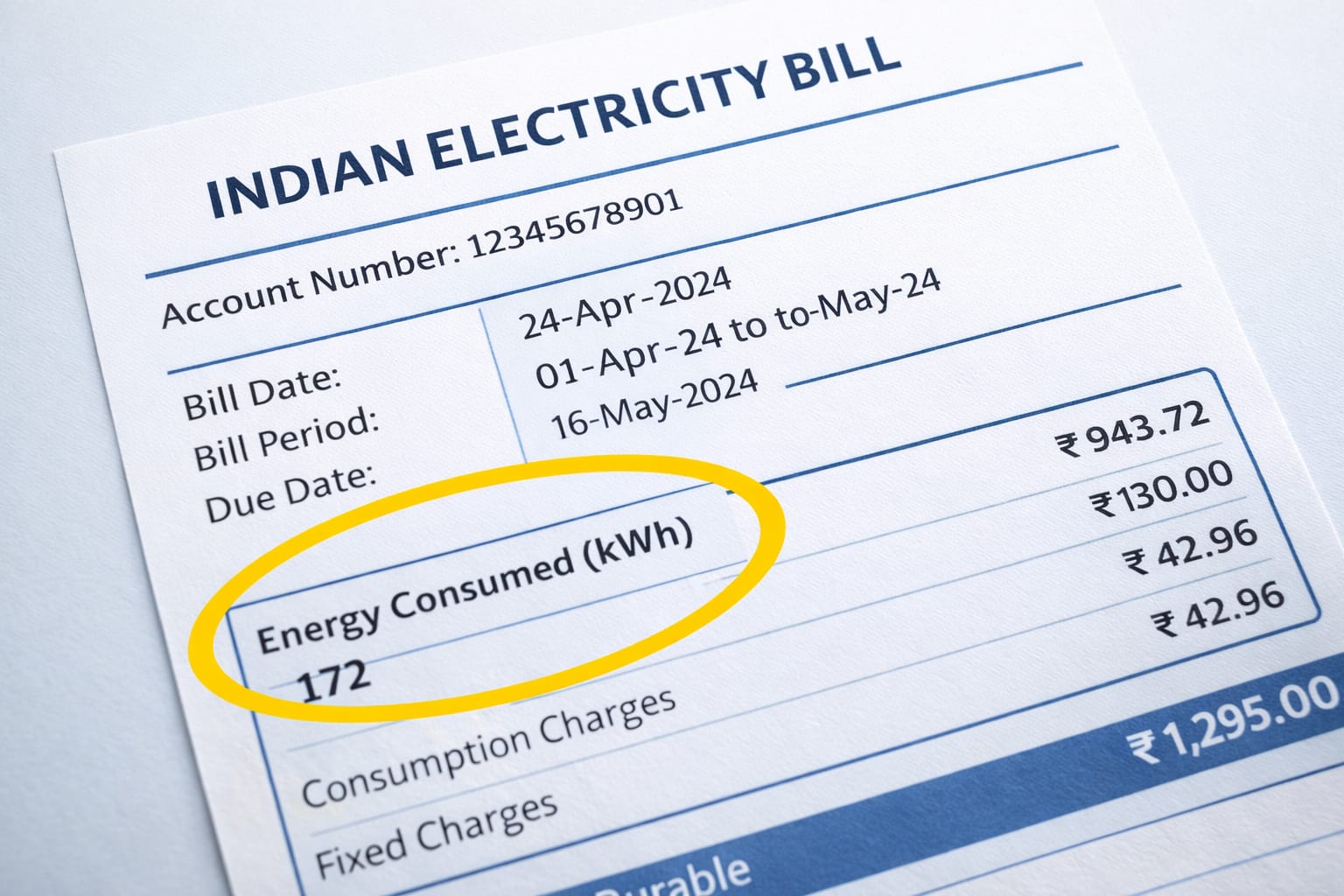
Locating Your Monthly Units (kWh)
Take your last 12 months of electricity bills. Look for a term like "Energy Consumed (kWh)" or simply "Units." A "unit" of electricity is 1 kilowatt-hour (kWh)—the amount of energy consumed by a 1,000-watt appliance running for one hour.
Calculate your average monthly consumption:
- Add up the total units consumed over 12 months
- Divide by 12 to get your average monthly consumption
For example: If your total annual consumption is 4,800 units, your average monthly consumption is 400 units.
Seasonal Variations: Summer vs. Winter Consumption
Indian homes typically have higher consumption in summer due to air conditioners and fans. Don't just take a yearly average. Look at your highest consumption month (usually May or June) and your lowest (usually January or February). A properly sized solar system should cover your summer peak to give you maximum benefit.
Step 2: Calculate Your Daily Energy Requirement
Now that you know your monthly consumption, let's convert it to a daily number.
The Simple Formula
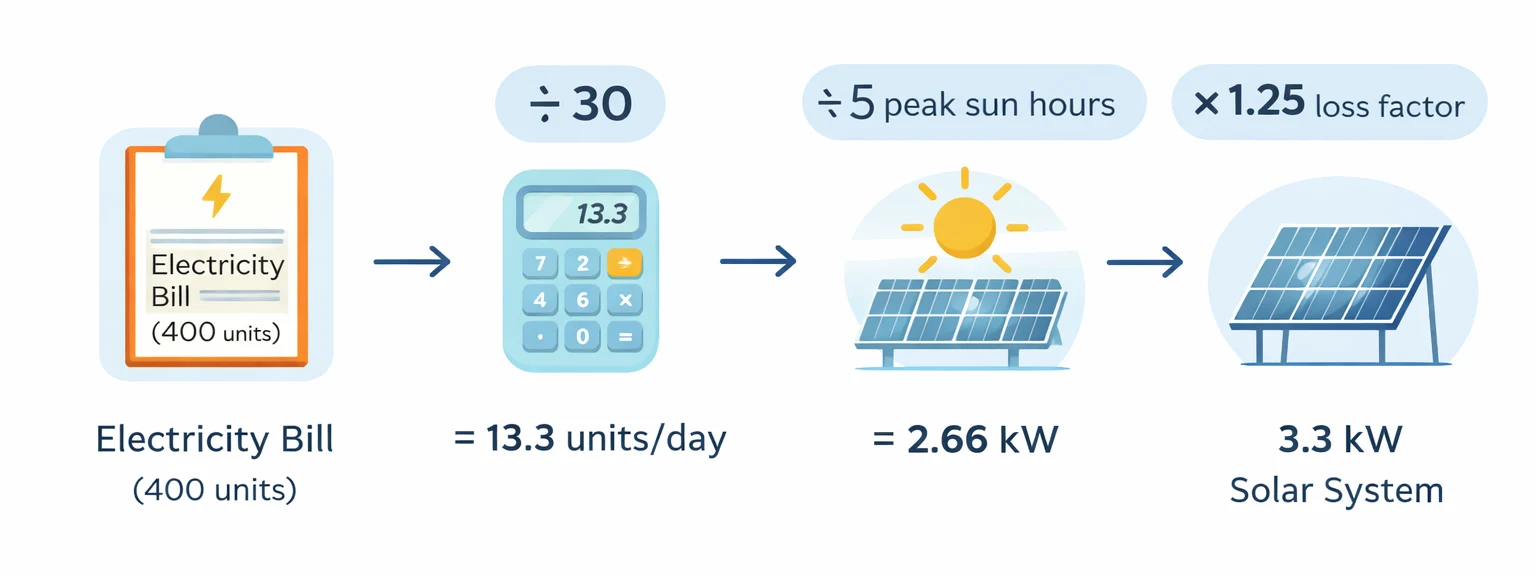
Daily Energy Requirement (kWh/day) = Average Monthly Consumption (kWh) ÷ 30 days
Using our example:
- 400 units per month ÷ 30 days = 13.33 kWh/day
This means your home consumes about 13-14 units of electricity every day on average.
Step 3: Determine Your Peak Sunlight Hours (Location Matters)
This is where India's geography plays a crucial role. Solar panels don't generate electricity at their rated capacity for all 12 hours of daylight. They only produce peak power during the hours when the sun is strongest.
In India, "Peak Sun Hours" vary by region and season:
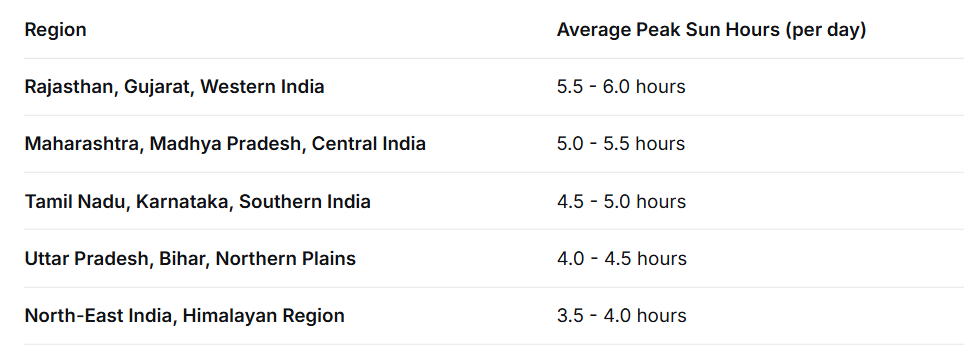
For calculation purposes, we'll use 5 peak sun hours as a conservative average for most of India. If you live in a region with lower sunlight, your system will need to be slightly larger.
Step 4: Calculate the Solar System Size (kW)
Now we arrive at the crucial calculation. To determine the system size in kilowatts (kW), we use this formula:
The Basic Solar Sizing Formula
System Size (kW) = Daily Energy Requirement (kWh/day) ÷ Peak Sun Hours (hours/day)
Using our example of a home requiring 13.33 kWh/day in a region with 5 peak sun hours:
- 13.33 kWh/day ÷ 5 hours/day = 2.67 kW
This calculation tells us that a 2.67 kW solar system would theoretically generate enough energy to meet your daily needs.
However, this is the "ideal" size. In practice, we need to account for system losses.
Account for System Losses (Add 20-25%)
No solar system is 100% efficient. Losses occur due to:
- Dust and dirt on panels (especially in Indian cities)
- Inverter efficiency (typically 95-98%)
- Wiring losses
- Temperature derating (as we discussed in our summer vs. winter guide)
Practical System Size = Ideal System Size × 1.25
- 2.67 kW × 1.25 = 3.34 kW
So, this home would need approximately a 3.3 kW to 3.5 kW solar system to comfortably meet its electricity needs.
Step 5: Understanding Solar System Types and Their Sizing
The system size we calculated is for an on-grid system. But depending on your needs, you might require a different configuration.
On-Grid System Sizing
This is the most common and cost-effective option for Indian homes. Your calculated size (3.3 kW in our example) is perfect for an on-grid system. You'll generate power during the day, use what you need, and export excess to the grid through net metering.
Ideal for: Homes with reliable grid power, wanting maximum savings with lowest investment.
Off-Grid System Sizing (Battery Backup)
If you experience frequent power cuts or want complete independence from the grid, you need an off-grid system with batteries. This requires a larger solar array to charge batteries during the day.
Formula for Off-Grid:
- Same solar array size (3.3 kW in our example) PLUS
- Battery capacity to store energy for nighttime and backup hours
Battery Size (kWh) = Daily Consumption × Backup Days Required
For 1 day of backup: 13.33 kWh of battery capacity (approximately 4-5 units of battery storage).
Ideal for: Areas with frequent power cuts, rural locations, homes wanting full energy independence.
Hybrid System Sizing
A hybrid system combines the best of both—grid connection with battery backup. The solar array size remains the same as on-grid, but you add a smaller battery for critical loads during outages.
Step 6: Calculate Your Required Number of Solar Panels
Once you know your system size in kW, calculating the number of panels is straightforward.
Number of Panels = System Size (Watts) ÷ Panel Wattage
In 2026, standard solar panels for homes come in two popular sizes:
- 540W panels: Common for larger installations
- 415W-445W panels: High-efficiency options
For a 3.3 kW (3,300 watt) system using 540W panels:
- 3,300 watts ÷ 540 watts = 6.1 panels (round up to 6 or 7 panels)
For a 3.3 kW system using 415W panels:
- 3,300 watts ÷ 415 watts = 7.9 panels (round up to 8 panels)
Real-World Examples: Sizing for Different Indian Homes
Let's apply our formula to typical Indian households.
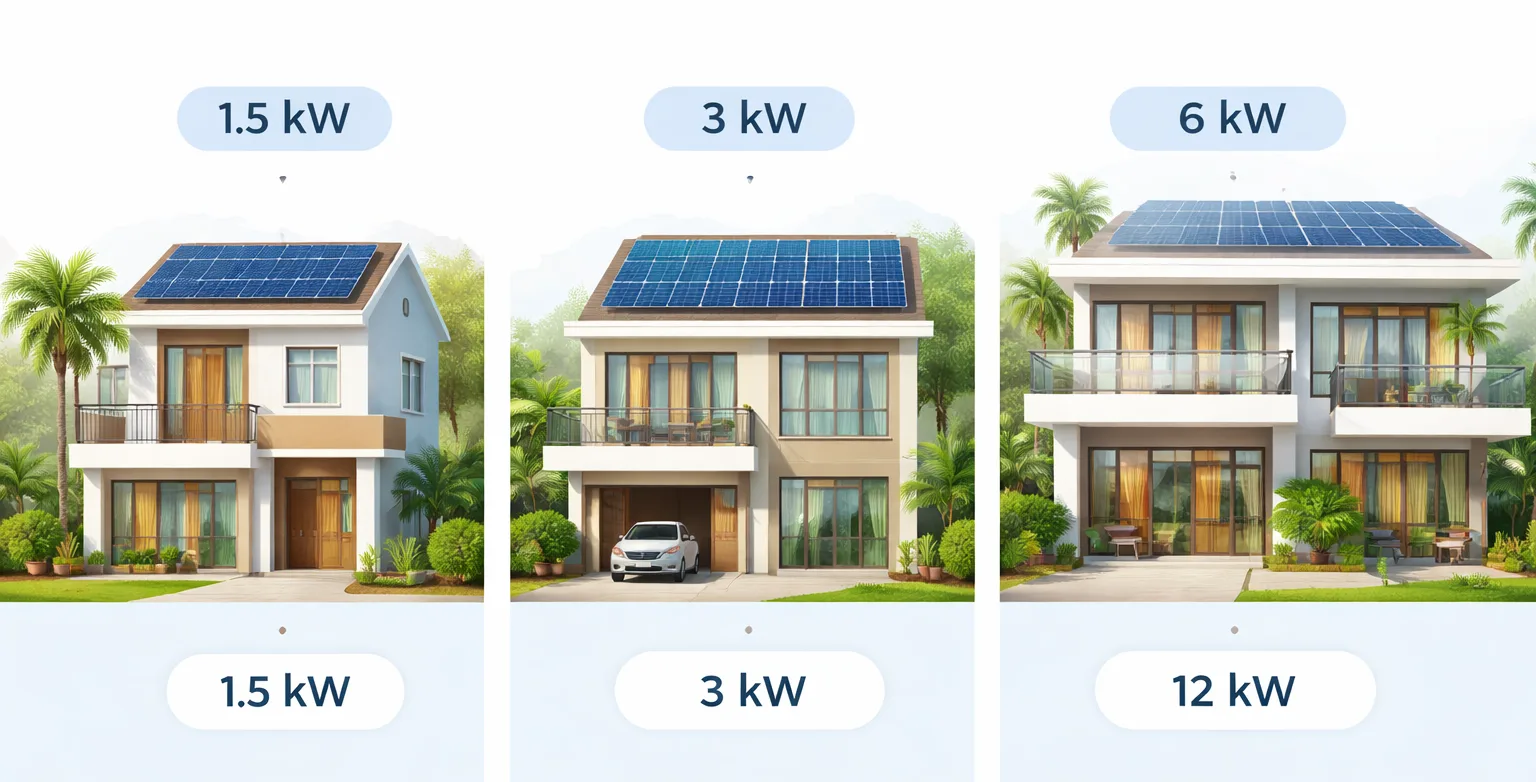
Example 1: Small Family (2-3 BHK, No AC)
- Monthly Consumption: 200 units
- Daily Requirement: 200 ÷ 30 = 6.67 kWh/day
- Ideal System Size: 6.67 ÷ 5 = 1.33 kW
- With Losses: 1.33 × 1.25 = 1.7 kW (approximately 1.5-2 kW system)
- Panels: 3-4 panels (540W each)
- Post-Subsidy Cost: Approximately ₹50,000-60,000 after ₹30,000 subsidy (for 2kW)
Example 2: Medium Family (3 BHK, 1-2 ACs)
- Monthly Consumption: 400 units
- Daily Requirement: 400 ÷ 30 = 13.33 kWh/day
- Ideal System Size: 13.33 ÷ 5 = 2.67 kW
- With Losses: 2.67 × 1.25 = 3.3 kW (approximately 3-3.5 kW system)
- Panels: 6-7 panels (540W each)
- Post-Subsidy Cost: Approximately ₹1,40,000-1,60,000 after ₹78,000 subsidy
Example 3: Large Family (4+ BHK, Multiple ACs, Home Office)
- Monthly Consumption: 800 units
- Daily Requirement: 800 ÷ 30 = 26.67 kWh/day
- Ideal System Size: 26.67 ÷ 5 = 5.33 kW
- With Losses: 5.33 × 1.25 = 6.7 kW (approximately 6-7 kW system)
- Panels: 12-13 panels (540W each)
- Post-Subsidy Cost: Approximately ₹3,50,000-4,00,000 after ₹78,000 subsidy (fixed subsidy for >3kW)
The PM Surya Ghar Subsidy: How System Size Affects Your Benefit
Under the PM Surya Ghar: Muft Bijli Yojana in 2026, the subsidy amount depends on your system size:
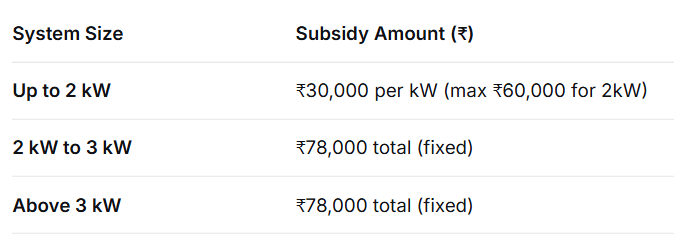
Important: The subsidy is capped at ₹78,000 regardless of how large your system is. This means for homes needing systems above 3 kW, the financial benefit per kW decreases, but the long-term savings still make excellent sense.
Common Mistakes to Avoid When Sizing Your Solar System
- Sizing Based on Roof Space Alone: Don't let an installer sell you a system based on "how many panels fit on your roof." Size should always be based on consumption first.
- Ignoring Future Growth: If you plan to buy an electric car, add a new AC, or expand your home in the next 3-5 years, factor that into your sizing now. Adding panels later is more expensive.
- Forgetting to Account for Losses: Many homeowners calculate the ideal size and wonder why their generation falls short. Always add the 20-25% buffer.
- Not Considering Net Metering Limits: Your local electricity board may have restrictions on how much solar capacity you can install based on your sanctioned load. Check with your DISCOM before finalizing.
Conclusion: Your Path to Energy Independence Starts Here
Calculating the right solar system size for your home doesn't have to be complicated. With your electricity bills and this simple formula, you're now equipped to have informed conversations with installers and avoid being upsold or undersold.
Remember the key steps:
- Know your consumption: Monthly units from your bill
- Calculate daily need: Units ÷ 30
- Factor your location: Peak sun hours in your region
- Apply the formula: Daily need ÷ peak sun hours × 1.25
- Choose the right system type: On-grid, off-grid, or hybrid based on your power cut situation
A properly sized solar system is an investment that pays for itself in 3-5 years and continues to save you money for the next 20-25 years. With the PM Surya Ghar subsidy making it more affordable than ever, there's never been a better time to take control of your electricity bills.


