

Solar Panel Direction and Tilt Angle for Maximum Output India
You’ve bought the best panels, picked a top-tier inverter, and secured your PM Surya Ghar subsidy. But there is one final, critical step that determines whether your system is a "gold mine" or a "money pit": The Orientation.
In India, a solar panel facing the wrong way or tilted at a bad angle can lose 10% to 25% of its generation potential. That’s like throwing away ₹2,000 every year for 25 years! This guide explains the science of "True South," the "Latitude Rule," and the specific angles required for major Indian cities in 2026.
1. The Golden Rule: Which Direction Should Solar Panels Face in India?
Since India is located in the Northern Hemisphere, the sun is always physically positioned in the southern half of our sky.
Why "True South" is the Only Choice
To capture the maximum amount of sunlight from sunrise to sunset, your solar panels must face True South.
- True South vs. Magnetic South: Your phone’s compass points to "Magnetic South." In India, there is a slight difference (declination). Professional installers use solar apps or specialized tools to find True South for 100% accuracy.
- What if I face them East or West? * East-facing: Good for morning heavy users (e.g., offices), but 15% less total daily energy.
- West-facing: Good for evening AC loads, but overall lower yield.
- North-facing: Avoid at all costs. In India, this is a waste of investment as the panels will stay in the "shadow" of their own tilt most of the day.
2. The Ideal Tilt Angle: The "Latitude Rule"
The "Tilt Angle" is the vertical slope of your panels. If they lie flat on the roof, the angle is 0°. If they stand straight up like a wall, it’s 90°.
The Thumb Rule for India
For a fixed, year-round installation, your Tilt Angle should be approximately equal to the Latitude of your city. By matching the angle to your latitude, you ensure that the sun’s rays hit the panels perpendicularly (at 90°) for the maximum number of hours throughout the year.

3. Recommended Tilt Angles for Indian Cities (2026)
India is a vast country. A tilt that works in Chennai will be a disaster in Srinagar. Use this table for your 2026 installation:
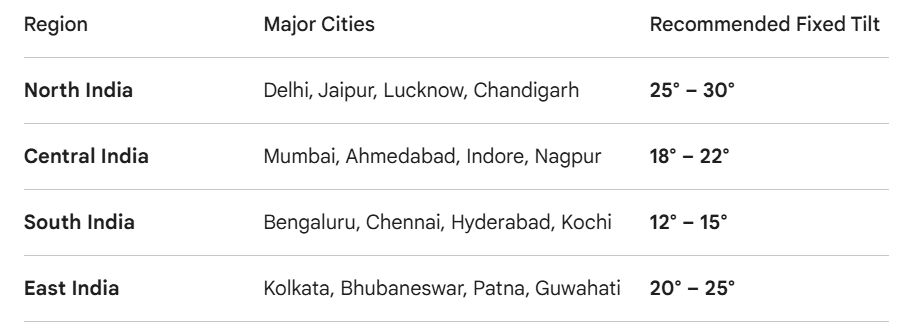
Pro Tip: In North India (like Delhi/Punjab), increasing the tilt by 5° (to around 35°) helps significantly in winter, when the sun is much lower in the sky and heating loads are high.
4. Seasonal Adjustments: Can You Get More?
If you have "Adjustable Manual Structures," you can increase your output by 8% to 12% by changing the angle twice a year:
- Summer (Feb to Sept): Reduce the tilt (Latitude minus 15°). The sun is overhead; flatter panels perform better.
- Winter (Oct to Jan): Increase the tilt (Latitude plus 15°). The sun is low in the south; steeper panels "catch" the rays better.
5. Avoiding the "Self-Shading" Trap
When installing multiple rows of panels on a flat RCC roof, the angle creates a problem: Shadows. A panel tilted at 30° in Delhi casts a long shadow behind it. If the next row is too close, its bottom half will be shaded, crashing the output of the entire string.
- Rule of Thumb: Ensure a gap of at least 1.5 times the height of the structure between two rows.
- Constraint: If your roof is small, you might have to choose a lower tilt (e.g., 15° instead of 25°) just to fit more panels without shading each other. Total generation is usually better with more "slightly inefficient" panels than fewer "perfectly angled" ones.
Conclusion: Setting Up for Success
Getting the direction and tilt right is a one-time task that pays off for 25 years.
- Always face True South.
- Use your City's Latitude as your base tilt angle.
- Check for shadows from water tanks or parapet walls between 9 AM and 4 PM.
FAQ Schema Markup
- Q: What happens if my solar panels face North in India?
- A: They will receive very little direct sunlight, mostly relying on reflected light. This can reduce your power generation by 50-70%, making the system non-viable.
- Q: Is 0° (flat) tilt good for Indian monsoons?
- A: No. Flat panels allow water and dust to pool, creating "hot spots" that can damage the cells. Always maintain at least a 10° tilt for natural drainage.
- Q: Does a 5-degree error in tilt matter?
- A: A small error of 5° usually results in less than a 2% loss in annual generation. Direction (South vs East/West) is much more important than a perfect tilt.


