

Solar Panel Efficiency in Indian Summer vs Winter: The Truth Revealed (2026)
As an Indian homeowner, you've likely noticed the scorching summer sun and thought, "This is perfect for solar power!" Conversely, you might look at a mild winter day and wonder if your panels are generating enough. This leads to a common question: Is solar panel efficiency higher in the blazing Indian summer or the cooler winter?
The answer, as you might suspect, isn't straightforward. While summer brings more daylight hours, it also brings a hidden enemy: heat. This guide will dive deep into the science of solar panel efficiency across India's dramatic seasons, bust common myths about the monsoon , and give you practical tips to maximize your system's performance year-round. We’ll look at real data for 2026 to help you make the most of your investment.
The Two Enemies of Solar Panels in India: Heat and Dust
To understand seasonal efficiency, you must first understand that solar panels are not like a car engine that loves heat. They are sophisticated electronic devices that actually prefer cooler conditions.
The Summer Heat Paradox (More Sun, Less Efficiency)
It seems counterintuitive, but a solar panel's efficiency drops as its temperature rises. Think of it like a mobile phone that slows down or warns you to cool off on a hot day. Solar panels operate on the same principle. They convert sunlight (light, not heat) into electricity. The intense infrared radiation from the summer sun heats up the panel's cells significantly.
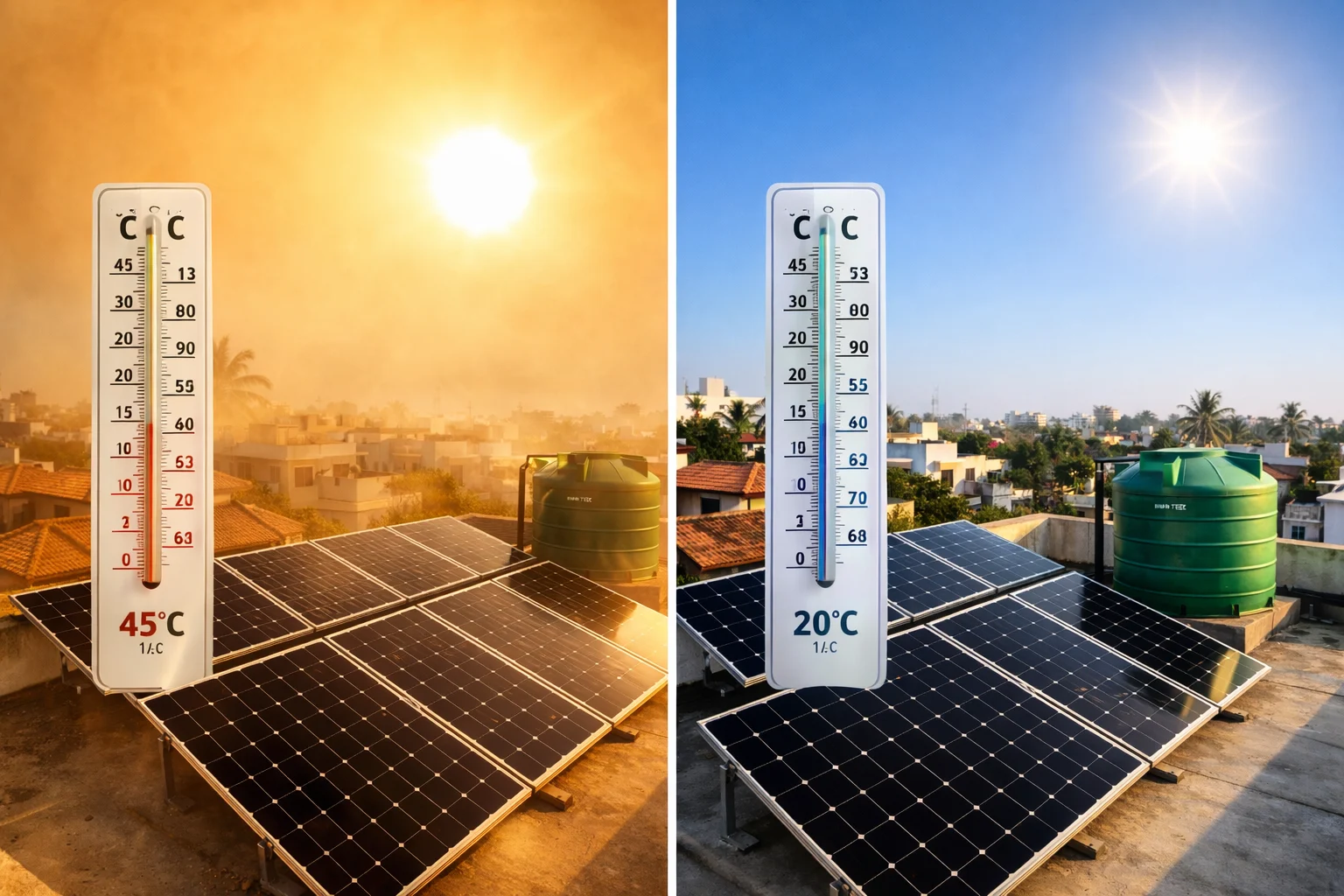
Research shows that for every 1°C rise in panel temperature above the standard test condition of 25°C, the efficiency drops by a certain percentage . In North India, panel temperatures can easily soar past 45°C-50°C on a summer afternoon. This "temperature coefficient" is why you might see a slight dip in power output during the peak heat hours, even though the sun is blazing.
The Winter Advantage (Cooler is Better)
This is where the magic happens. During winter, the ambient temperature is lower, often between 10°C and 20°C in many parts of India. This keeps the solar panels cool, allowing them to operate much closer to their ideal temperature. The clear, crisp winter air also means less atmospheric scattering of sunlight.
The result? While the days are shorter, the panels operate at a higher efficiency rate per hour of sunlight. You might be surprised to see your generation starting strong in the morning and continuing efficiently throughout the day, without the mid-day slump caused by excessive heat. Studies on solar photovoltaic pumping systems confirm that conversion efficiency decreases as panel temperature rises across all seasons .
What the Data Says: Seasonal Performance Across India
Let's look at some numbers that illustrate this seasonal and regional dance.
Regional Variations in Efficiency
India's vast geography means the summer vs. winter performance varies significantly. A comprehensive 2025 study published in the AIP Conference Proceedings analyzed solar panel performance across different Indian regions and found clear seasonal patterns .
- Northern Region: Efficiency is at its highest during the summer month at 19%, but hits its lowest during the winter month at 16% . This significant 3% swing shows the impact of both extreme cold (less sun) and extreme heat on performance.
- Overall Regional Efficiency: The study highlighted that the South zone achieves the highest average efficiency (20%), followed by the West (19%), North (18%), East (17%), and Central (16%) regions . This data underscores how local climate and solar irradiance are key to performance.
The Temperature Coefficient Explained
The "temperature coefficient" is a critical spec to look for when buying panels, especially in India. It tells you how much power output will decrease for every degree Celsius the panel heats up above 25°C.
- Standard Panels: Older or standard panels might have a coefficient of around -0.40% to -0.45% per °C.
- Advanced Panels (TOPCon & HJT): Newer technologies are much better at handling heat. For instance, Gautam Solar's new TOPCon modules boast a temperature coefficient of just -0.29%/°C . Even more impressive, Vikram Solar's heterojunction (HJT) modules have a coefficient of -0.26%/°C . Adani Solar's TOPCon bifacial panels also feature a low coefficient of -0.31%/°C .
This means on a 45°C day (20°C above standard), a panel with a -0.26% coefficient will lose only 5.2% efficiency, while a panel with a -0.40% coefficient would lose 8% efficiency. For an Indian home, investing in panels with a superior temperature coefficient is a smart, long-term move.
Busting the Monsoon Myth: Do Panels Work in the Rain?
This is perhaps the biggest question for Indian homeowners. The monsoon season brings heavy clouds and rain, leading many to believe their solar system will be useless for months. This is a myth that needs busting.
Modern solar panels are incredibly effective at capturing diffused sunlight—the light that penetrates through cloud cover. As noted by industry experts, panels in India can still produce a significant amount of power during the monsoon, typically only experiencing a 10-20% reduction in output, not a complete shutdown . A typical residential system can still generate 7-8 units per day from diffused light .
Think of countries like Germany and the UK, which have far cloudier climates than India but are global leaders in solar power . If solar works there, it will certainly work during an Indian monsoon.
Here's a bonus: The monsoon actually helps your panels. The rain acts as a natural cleaning mechanism, washing away the dust and bird droppings that accumulate during the dry months, which can block sunlight and reduce efficiency by a significant margin .
How to Maximize Your Solar Panel Efficiency Year-Round
Want to get the best performance whether it's a scorching summer or a mild winter? Here are three actionable tips.
1. Optimize Your Panel Tilt Angle
Most Indian rooftops have fixed-tilt panels, usually set at an angle equal to the location's latitude to maximize annual yield. However, research from Rajasthan Technical University shows that adjusting the tilt seasonally can boost output by up to 9% .
- Summer (March-August): The sun is high overhead. A flatter tilt (0°-15°) helps panels capture more direct overhead light.
- Winter (November-January): The sun is lower in the sky. A steeper tilt (45°-60°) angles the panel to face the sun more directly .
If you have an adjustable mounting structure, changing the tilt twice a year is a great way to optimize generation. If not, a compromise angle (close to your latitude) is still highly effective.
2. Keep Them Clean
Dust is a major efficiency killer in India. A layer of dust can reduce efficiency by 5-20%. While the monsoon provides a free wash, you should manually clean your panels with water and a soft squeegee during the dry pre-summer and post-monsoon months. Aim for early morning or late evening cleaning to avoid thermal shock from cold water on hot panels.
3. Choose the Right Technology
When buying a new system in 2026, prioritize panels with a low temperature coefficient and high efficiency.
- TOPCon (Tunnel Oxide Passivated Contact): As seen with Gautam Solar and Adani Solar, this N-type technology offers better efficiency and a lower degradation rate than older P-type panels .
- HJT (Heterojunction Technology): Vikram Solar's HJT modules offer some of the best temperature coefficients on the market, making them ideal for hot climates .
Conclusion: The Sun Always Shines on Solar
So, is solar panel efficiency higher in Indian summer or winter? The answer is: you get the best of both worlds. Winter offers the highest efficiency per hour of sunlight, while summer offers the longest hours of generation. The monsoon, far from being a washout, continues to provide clean energy and even helps clean your panels.
By understanding these dynamics and choosing the right equipment, you can ensure your rooftop solar system delivers excellent returns, rain or shine, all year long.


