

Introduction: The Question Every Solar Buyer Asks
You are sitting in a solar company's office in Bengaluru. The salesman just showed you impressive daytime generation graphs—your proposed 5kW system will generate 22 units daily, slashing your ₹6,400 monthly bill to nearly zero. You are impressed. Then a question hits you:
"What happens at night? Solar panels need sunlight. After sunset, do I go back to paying full BESCOM rates? What's the point then?"
This is the single most common question Indian homeowners ask—and the answer determines whether solar makes sense for your home.
Here is the reality that might surprise you: Solar panels generate exactly zero electricity at night. This is physics, not a flaw. But here is what salespeople often fail to explain clearly: Your home still has 24/7 power at near-zero cost through a system called net metering—a policy where the grid acts as a free, unlimited virtual battery.
However, net metering is not the only solution. For homes in areas with frequent power cuts (rural UP, Bihar, parts of Odisha), battery storage systems make sense despite their ₹2-4 lakh additional cost. For most urban Indians in Mumbai, Delhi, Bengaluru, Chennai, and Pune with reliable DISCOM supply, batteries are an expensive waste—but installers push them anyway to boost commissions.
This complete 2026 guide explains exactly what happens to your solar panels after sunset, how net metering provides nighttime power for free, when battery systems are genuinely worth it (and when they are money pits), and real solutions for Indian homes across different grid reliability scenarios. By the end, you will understand the nighttime power equation better than most solar installers.
Let us start with the physics.
The Physics: Why Solar Panels Don't Generate at Night
The Simple Explanation:
Solar panels work through the photovoltaic effect—sunlight (photons) hits silicon cells, knocking electrons loose, creating electric current. At night:
- No sunlight = No photons
- No photons = No electron movement
- No electron movement = Zero electricity generation
This is fundamental physics. Solar panels are not batteries—they do not store energy. They are converters—transforming light energy into electrical energy in real-time.
What About Moonlight?
Moonlight is reflected sunlight—theoretically, it could generate electricity. Reality:
- Moonlight intensity: 400,000 times weaker than sunlight
- A 5kW system under full moon: Generates 0.01-0.02 watts (essentially nothing)
- Not enough to power even a single LED bulb (5 watts minimum)
What About Starlight or City Lights?
Even less effective than moonlight. Ambient city lighting might generate 0.001-0.005 watts—completely negligible.
The Bottom Line:
From sunset to sunrise (approximately 6 PM to 6 AM in India), your solar panels sit idle. They are not broken. They are not underperforming. They are waiting for photons. This is normal, expected, and accounted for in all solar ROI calculations.
The real question is not "Do panels work at night?" but rather "How does my home get power at night?"
Two solutions exist: Net metering (grid connection) or battery storage. Let's explore both.
What Actually Happens After Sunset (Step-by-Step)
Let's walk through a typical 24-hour cycle for a grid-connected solar home in Mumbai:
Morning (6:00 AM - 9:00 AM):
- Sunrise at 6:15 AM
- Solar panels start generating: 0.5 kW (6:30 AM) → 2.5 kW (8:00 AM) → 3.8 kW (9:00 AM)
- Home consumption: 1.2 kW (morning routine—geyser, lights, kitchen appliances)
- Surplus power: 2.6 kW flows to DISCOM grid via net metering
- Bidirectional meter records: +2.6 kW export (you are sending power to grid)
Midday (9:00 AM - 3:00 PM):
- Peak generation: 4.8-5.0 kW (noon sun directly overhead)
- Home consumption: 0.8 kW (minimal—most people at work/school, only fridge running)
- Surplus power: 4.2 kW flows to grid
- Bidirectional meter records: +25.2 kWh export (6 hours × 4.2 kW average)
Afternoon (3:00 PM - 6:00 PM):
- Solar generation declining: 3.5 kW (3 PM) → 1.8 kW (5 PM) → 0.2 kW (6 PM)
- Home consumption increasing: 2.5 kW (ACs turned on as people return home)
- Power flow: Still some surplus to grid initially, then balanced, then slight import from grid
- Bidirectional meter: +3.6 kWh export (net for this period)
Sunset Transition (6:00 PM - 6:30 PM):
- Solar generation: 0.2 kW → 0.05 kW → 0 kW (sunset at 6:28 PM)
- Home consumption: 3.5 kW (ACs running, lights on, cooking, TV)
- Power source switches automatically from solar to grid
- Your inverter detects dropping solar voltage, seamlessly transitions to grid import
- You notice nothing—lights do not flicker, AC keeps running
Evening/Night (6:30 PM - 11:00 PM):
- Solar generation: 0 kW (panels idle)
- Home consumption: 3.8 kW (peak usage—2 ACs, lights, TV, cooking, water heater)
- Power source: 100% from DISCOM grid
- Bidirectional meter records: -19 kWh import (5 hours × 3.8 kW)
Late Night (11:00 PM - 6:00 AM):
- Solar generation: 0 kW
- Home consumption: 1.2 kW (1 AC, fridge, minimal lights)
- Power source: DISCOM grid
- Bidirectional meter: -8.4 kWh import (7 hours × 1.2 kW)
Daily Summary (Midnight to Midnight):
- Solar generated: 23 units (kWh)
- Home consumed: 24 units total
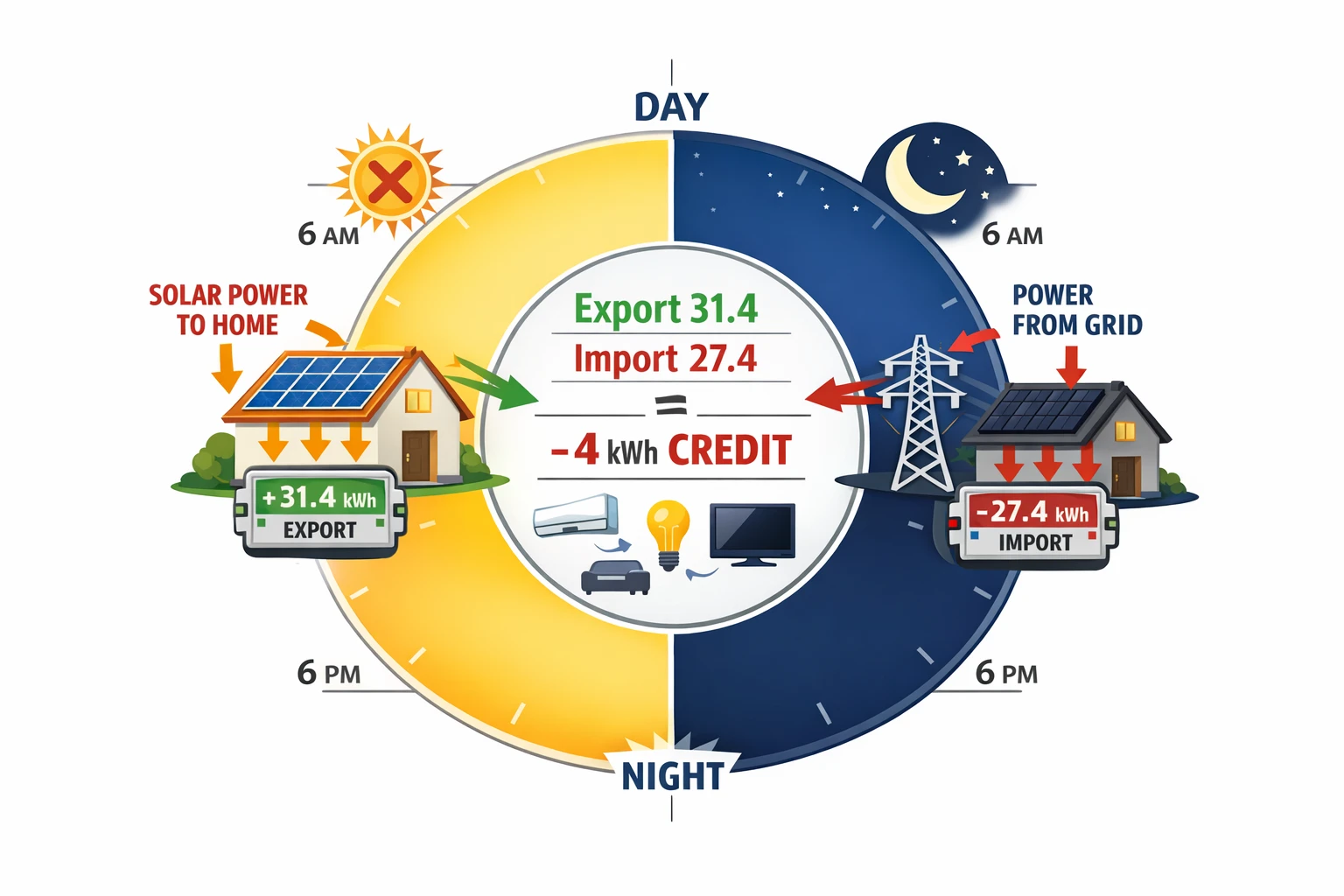
- Exported to grid (daytime surplus): 31.4 units
- Imported from grid (nighttime + low-gen periods): 27.4 units
- Net import: 27.4 - 31.4 = -4 units
- Translation: You exported 4 units more than you imported
- Bill impact: DISCOM owes you 4 units credit (carries forward to next month)
Key Insight: Your panels generated zero electricity for 12 hours (6 PM - 6 AM), yet your home had continuous power. Net metering made this possible.
Net Metering: Your Free Virtual Battery (How It Works)
Net metering is the financial and technical framework that makes nighttime solar feasible without batteries.
What Is Net Metering?
Net metering is a billing mechanism where:
- Your DISCOM installs a bidirectional meter (measures power flowing both directions)
- During daytime: Excess solar power flows TO grid (you export, meter spins backward)
- During nighttime: You draw power FROM grid (you import, meter spins forward)
- Monthly billing: You pay only for (Import - Export) units
Why It's Called "Net" Metering:
Traditional meter: Measures only import Bidirectional meter: Measures import AND export Bill calculation: Net consumption (Import minus Export)
Example:
Without Solar (Traditional):
- Monthly consumption: 650 units
- All imported from grid
- Bill: 650 units × ₹8.50/unit = ₹5,525
With Solar (Net Metering):
- Monthly consumption: 650 units (same usage)
- Solar generation: 690 units
- Daytime surplus export: 390 units
- Nighttime import: 350 units
- Net import: 350 - 390 = -40 units (you exported 40 more than you imported)
- Bill: ₹0 (zero, you owe nothing)
- Bonus: 40-unit credit rolls over to next month in most states
Why Net Metering Is Brilliant:
Think of the grid as a free, unlimited battery:
- Daytime: Your solar panels "charge" the grid (export surplus)
- Nighttime: You "discharge" the grid (import what you need)
- Cost: Zero storage fees, zero battery degradation, infinite capacity
- Efficiency: 100% (unlike batteries which lose 8-15% in round-trip conversion)
Comparison:
Physical Battery (10 kWh lithium):
- Purchase cost: ₹2,50,000-3,00,000
- Lifespan: 7-10 years
- Replacement cost: ₹2,00,000-2,50,000 (every 7-10 years)
- Round-trip efficiency: 85-92% (lose 8-15% in charge/discharge)
- Maintenance: ₹2,500-4,000 annually
Net Metering (Grid as Virtual Battery):
- Setup cost: ₹8,000-12,000 (bidirectional meter + DISCOM fees)
- Lifespan: Unlimited (as long as grid exists)
- Replacement cost: ₹0
- Efficiency: 100% (no conversion losses)
- Maintenance: ₹0 annually
The Financial Math:
For urban Indian homes with reliable grid, net metering saves ₹2.4-3 lakh upfront and ₹2-2.5 lakh every 7-10 years (battery replacement). Over 25 years, that is ₹6-8 lakh saved by using grid instead of batteries.
Net Metering Policies in India (2026):
All states have net metering regulations (mandated by Electricity Act 2003 amendments). Quality varies:
Excellent (1:1 Credit, Annual Rollover):
- Gujarat, Karnataka, Delhi, Maharashtra, Rajasthan
- You get full credit for exports (₹8/unit consumed = ₹8/unit exported)
- Surplus credits roll over 12 months
Good (1:1 Credit, Quarterly Settlement):
- Tamil Nadu, Andhra Pradesh, Telangana
- Credits settle every 3 months (excess paid at avoided cost rate)
Average (Net Billing, Slightly Lower Credit):
- Kerala, Punjab, Madhya Pradesh
- Export credit at wholesale rate (₹4-5/unit) vs retail consumption (₹7-9/unit)
Challenging (Policy Exists, Implementation Slow):
- Uttar Pradesh, Bihar, Jharkhand
- Net metering available but DISCOM approval delays (45-90 days vs 15-30 days elsewhere)
The Truth: Net metering is the single best invention for residential solar. It solves the nighttime problem for 85% of Indian homes at zero ongoing cost.
Real Example: 24-Hour Power Flow for Mumbai Home
Let's examine a real family's complete 24-hour solar journey with exact numbers:
Family Profile:
- Location: Andheri West, Mumbai (Adani Electricity)
- Home: 3 BHK apartment, 4 people
- Solar system: 5 kW on-grid (no battery)
- Installation: September 2024 (18 months ago)
Appliances:
- 2 × 1.5-ton ACs (main bedroom + living room)
- 1 × 265L refrigerator
- 12 LED lights
- 2 ceiling fans
- 1 washing machine
- 1 LED TV
- Kitchen appliances (mixer, microwave occasional use)
Typical February Day (2026) Breakdown:
6:00 AM:
- Solar generation: 0 kW (still dark)
- Consumption: 1.8 kW (geyser heating water, kitchen lights, fridge)
- Source: Grid import
- Meter: Importing 1.8 kW
7:30 AM:
- Solar generation: 1.5 kW (sunrise at 7:02 AM, panels warming up)
- Consumption: 2.2 kW (family getting ready, all lights, geyser, TV)
- Source: 1.5 kW solar + 0.7 kW grid
- Meter: Importing 0.7 kW
10:00 AM:
- Solar generation: 4.2 kW (morning sun strong)
- Consumption: 0.9 kW (everyone left for work/school, only fridge + minimal lights)
- Surplus: 3.3 kW exported to grid
- Meter: Exporting 3.3 kW (running backward)
1:00 PM:
- Solar generation: 5.0 kW (peak noon generation)
- Consumption: 0.8 kW (home empty except fridge)
- Surplus: 4.2 kW exported
- Meter: Exporting 4.2 kW
4:00 PM:
- Solar generation: 3.0 kW (afternoon, sun angle decreasing)
- Consumption: 1.2 kW (washing machine running, some lights)
- Surplus: 1.8 kW exported
- Meter: Exporting 1.8 kW
6:30 PM:
- Solar generation: 0.1 kW (sun setting, panels nearly idle)
- Consumption: 3.8 kW (family home, 2 ACs on, cooking, TV, lights)
- Import needed: 3.7 kW from grid
- Meter: Importing 3.7 kW (seamless transition, no interruption)
9:00 PM:
- Solar generation: 0 kW (dark for 2.5 hours already)
- Consumption: 4.2 kW (peak evening—2 ACs running, all lights, TV, kitchen)
- Source: 100% grid
- Meter: Importing 4.2 kW
12:00 Midnight:
- Solar generation: 0 kW
- Consumption: 1.5 kW (1 AC in bedroom, fridge, few lights)
- Source: Grid
- Meter: Importing 1.5 kW
3:00 AM:
- Solar generation: 0 kW
- Consumption: 1.2 kW (AC + fridge only)
- Source: Grid
- Meter: Importing 1.2 kW
Daily Totals:
- Solar generated: 21 units (Mumbai has some monsoon tail-end clouds in Feb)
- Home consumed: 22 units
- Daytime export: 28.5 units (surplus when generation > consumption)
- Nighttime/low-gen import: 29.5 units
- Net import: 29.5 - 28.5 = 1 unit
Monthly Bill:
- Net consumption: 30 units (1 unit/day × 30 days)
- Adani tariff (0-100 units slab): ₹5.37/unit
- Bill: 30 × ₹5.37 = ₹161
Previous Bill (Before Solar, Same Consumption):
- 22 units/day × 30 = 660 units/month
- Adani tariff (501-800 slab): ₹9.14/unit
- Bill: 660 × ₹9.14 = ₹6,032
Monthly Savings: ₹6,032 - ₹161 = ₹5,871
Mr. Sharma's Quote: "People ask me, 'What do you do at night without battery?' I show them my bill—₹161. They are shocked. They think you need ₹3 lakh battery to make solar work. Net metering is the secret nobody explains properly. My panels sleep at night; the grid takes over. I barely notice the transition."
Battery Storage Systems: When They Make Sense
Despite net metering being superior for most homes, battery storage makes financial sense in specific scenarios:
Scenario 1: Frequent Power Cuts (>4 Hours Daily)
Location: Rural Uttar Pradesh village, UPPCL supply Problem: 6-8 hours daily scheduled power cuts (2 PM - 6 PM, 10 PM - 2 AM common) Solar alone: Panels generate during 2-6 PM cuts but useless during 10 PM - 2 AM cuts Solution: 5 kW hybrid system + 10 kWh lithium battery
Cost Breakdown:
- Solar panels + hybrid inverter: ₹3,20,000
- 10 kWh lithium battery: ₹2,80,000
- Total: ₹6,00,000
- PM Surya Ghar subsidy: -₹78,000
- Net investment: ₹5,22,000
Benefits:
- Daytime generation: 22 units/day
- Battery stores 8-10 units (80-100% battery capacity)
- Powers critical loads during 10 PM - 2 AM cuts (lights, fans, TV, fridge)
- Remaining daytime surplus exports via net metering
ROI:
- Previous cost (diesel genset): ₹400/day × 365 = ₹1,46,000/year
- Electricity bill savings: ₹42,000/year
- Total annual savings: ₹1,88,000
- Payback: 5,22,000 ÷ 1,88,000 = 2.8 years
Verdict: Battery justified—saves on diesel, provides reliable backup.
Scenario 2: Off-Grid Locations (No Grid Connection)
Location: Farmhouse in Alibaug, Maharashtra (no MSEDCL connection) Current setup: Diesel genset (₹85,000/year fuel cost) Solar solution: 7 kW off-grid system + 20 kWh lithium battery
Cost:
- Panels + off-grid inverter: ₹4,20,000
- 20 kWh battery: ₹5,50,000
- Total: ₹9,70,000
- No subsidy (off-grid ineligible for PM Surya Ghar)
- Net investment: ₹9,70,000
Benefits:
- 100% energy independence
- Zero diesel costs
- Zero grid connection fees (₹2-4 lakh to get MSEDCL connection in remote area)
ROI:
- Diesel savings: ₹85,000/year
- Grid connection avoided: ₹3,00,000 (one-time)
- Effective investment: ₹9,70,000 - ₹3,00,000 = ₹6,70,000
- Payback: 6,70,000 ÷ 85,000 = 7.9 years
- Battery replacement Year 8: ₹4,50,000
Verdict: Battery necessary (no grid alternative). ROI reasonable considering diesel costs and remote location.
Scenario 3: Time-of-Use (ToU) Tariffs
Location: Delhi (few DISCOMs experimenting with ToU in 2026) Tariff structure:
- Off-peak (11 PM - 6 AM): ₹4.50/unit
- Standard (6 AM - 6 PM): ₹7.00/unit
- Peak (6 PM - 11 PM): ₹11.50/unit
Strategy: Store cheap solar electricity in battery during day, use during expensive peak evening hours instead of importing at ₹11.50/unit.
System: 5 kW hybrid + 10 kWh battery
Daily Operation:
- Generate 23 units during day
- Use 5 units during daytime
- Store 10 units in battery (80% DoD)
- Export 8 units surplus (₹7/unit = ₹56)
- Evening peak (6-11 PM): Use 8 units from battery (saves ₹11.50/unit × 8 = ₹92)
- Late night (11 PM - 6 AM): Import 3 units from grid (₹4.50/unit × 3 = ₹13.50)
Daily savings: ₹92 (peak avoided) + ₹56 (export) - ₹13.50 (import) = ₹134.50/day Annual savings: ₹49,093 (vs ₹42,000 without ToU optimization)
Extra battery benefit: ₹7,093/year Battery cost: ₹2,80,000 Battery payback (extra benefit only): 39 years ❌
Verdict: Battery NOT justified even with ToU. The ₹7K/year extra savings does not offset ₹2.8L cost.
When Battery Does NOT Make Sense:
Scenario 4: Mumbai/Bengaluru/Delhi Tier 1 City with Reliable Grid
- Power cuts: <1 hour monthly
- Net metering: Available, functional
- Grid reliability: 99.5%+
- Battery cost: ₹2.8L for 10 kWh lithium
- Battery usage: <10 hours/year (during rare outages)
- Cost per use: ₹28,000/hour of backup (absurd)
Better solution: ₹12,000 home UPS for critical loads (router, laptop, lights) during rare outages.
The Math:
- Battery system: ₹2,80,000
- UPS for critical loads: ₹12,000
- Savings: ₹2,68,000
- Invest ₹2.68L @ 8% annual: Earns ₹21,440/year
- Over 25 years: ₹5,36,000 extra by avoiding battery
Verdict: Battery is a ₹5.36 lakh mistake for reliable grid areas.
Grid-Connected vs Off-Grid vs Hybrid Systems Compared
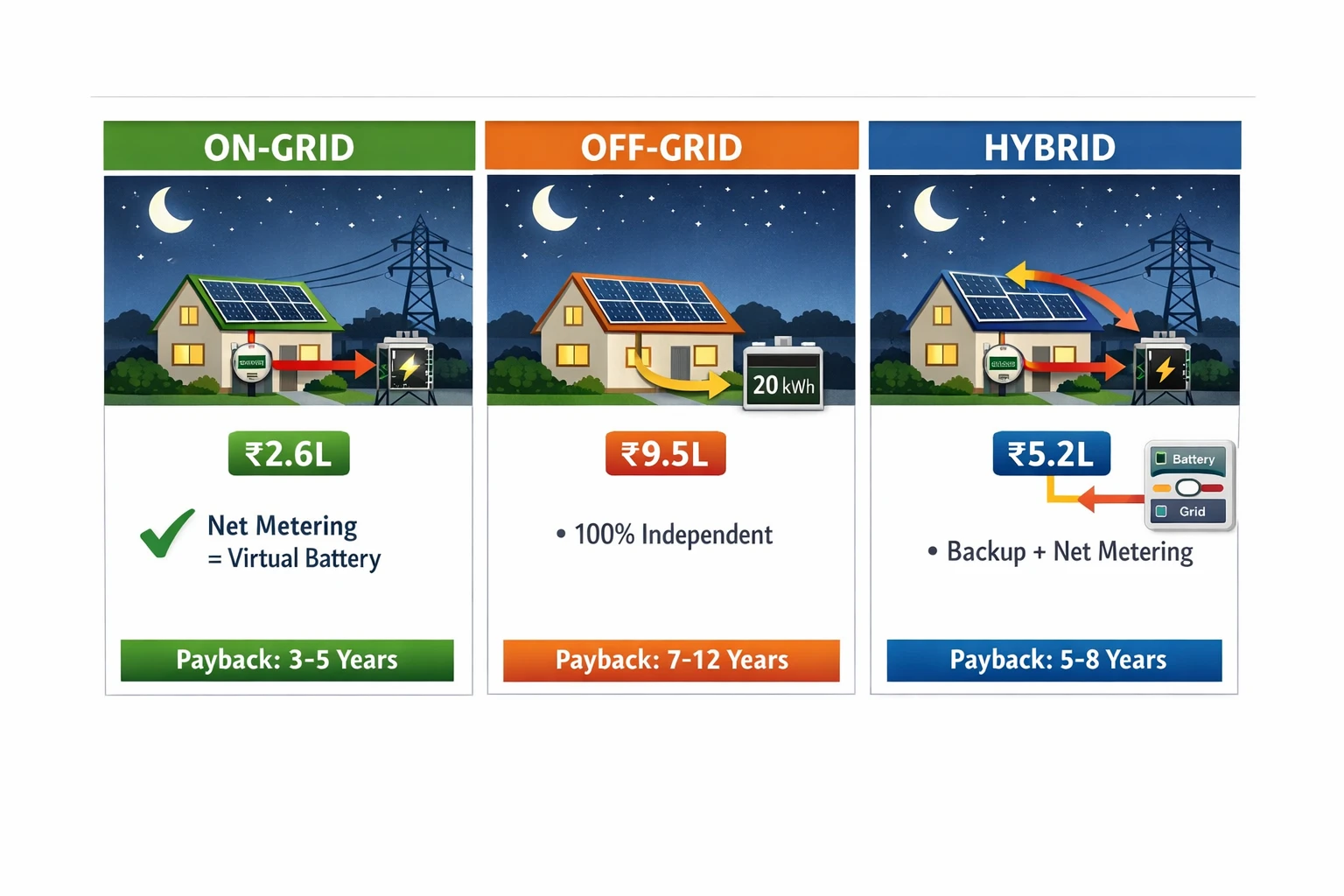
Grid-Connected (On-Grid) - 90% of Urban India:
How it works:
- Solar panels → String inverter → Home + Grid (via net metering)
- No battery
- Daytime: Solar powers home + exports surplus
- Nighttime: Grid powers home
Cost (5kW): ₹2,62,000 (after ₹78K subsidy)
Pros:
- Lowest cost
- Net metering = virtual battery (free, unlimited)
- Simple, proven technology
- Minimal maintenance
Cons:
- No backup during grid outages (rare in tier 1 cities)
- Dependent on DISCOM supply
Best for: Mumbai, Delhi, Bengaluru, Chennai, Pune—reliable grid, functional net metering
Off-Grid - Remote/No Grid Connection:
How it works:
- Solar panels → Off-grid inverter + Battery bank → Home (isolated from grid)
- Large battery bank (15-25 kWh for 5kW system)
- 100% self-sufficient
Cost (5kW): ₹8,50,000 - ₹11,00,000
- Panels + inverter: ₹3,00,000
- Battery (20 kWh lithium): ₹5,50,000 - ₹8,00,000
Pros:
- Complete energy independence
- No DISCOM bills ever
- Immune to grid failures
Cons:
- Extremely expensive upfront
- Battery replacement every 7-10 years (₹4.5-6.5L)
- Oversizing needed (panels + battery must cover worst-case consumption + 3-5 days backup)
- No PM Surya Ghar subsidy (grid connection required)
Best for: Farmhouses, remote villages, areas where grid connection costs ₹2-5 lakh
Hybrid - Best (or Worst) of Both Worlds:
How it works:
- Solar panels → Hybrid inverter + Battery + Grid connection
- Battery acts as backup during outages
- Net metering available when grid is up
- Can operate in three modes: solar priority, battery priority, grid priority
Cost (5kW): ₹5,20,000 - ₹6,80,000
- Panels + hybrid inverter: ₹2,40,000
- Battery (10 kWh): ₹2,80,000 - ₹4,40,000
- PM Surya Ghar subsidy: -₹78,000
- Net: ₹4,42,000 - ₹6,02,000
Pros:
- Backup during outages
- Can use ToU tariff optimization (if available)
- Future-proof (start without battery, add later)
Cons:
- Expensive (2x on-grid cost)
- Battery replacement costs (₹2-4L every 7-10 years)
- Complexity (more failure points)
- Lower ROI (payback 5-8 years vs 3-5 years on-grid)
Best for:
- Frequent power cut areas (4+ hours daily)
- Critical load requirements (medical equipment, business)
- States with ToU tariffs (rare in India 2026)
Avoid if: You have reliable grid. The ₹2.8L battery sits idle 99% of the time in cities.
Calculating Your Nighttime Power Needs
Before deciding on batteries, calculate your actual nighttime consumption:
Step 1: List Nighttime Appliances (6 PM - 6 AM)
Example home:
- 1 AC (1.5 ton): 1,500W × 8 hours = 12 kWh
- Refrigerator: 150W × 12 hours = 1.8 kWh
- LED lights (8 × 10W): 80W × 6 hours = 0.48 kWh
- TV: 100W × 4 hours = 0.4 kWh
- Wi-Fi router + gadget charging: 50W × 12 hours = 0.6 kWh
Total nighttime consumption: 15.28 kWh
Step 2: Identify Critical vs Non-Critical Loads
Critical (must-have during outages):
- Fridge: 1.8 kWh
- Lights (minimal): 0.2 kWh
- Router: 0.6 kWh
- Total critical: 2.6 kWh
Non-critical (can skip during outages):
- AC: 12 kWh
- TV: 0.4 kWh
Step 3: Size Battery (If Needed)
For full nighttime backup:
- Need: 15.28 kWh
- Battery size (accounting for 80% DoD): 19 kWh
- Cost: ₹5,20,000 - ₹7,00,000 (lithium)
For critical loads only:
- Need: 2.6 kWh
- Battery size: 3.25 kWh (4 kWh standard)
- Cost: ₹1,10,000 - ₹1,50,000
Step 4: Alternative Solutions
For critical loads in tier 1 cities: Instead of ₹1.5L battery, consider:
- Home UPS (1.5 kWh, 3-4 hour backup): ₹12,000 - ₹18,000
- Powers fridge, lights, router during rare outages
- Saves ₹1.32L vs battery
For non-critical loads (AC):
- Accept: AC won't work during outages (acceptable for <1 hour/month cuts)
- Or: Small portable generator (₹35,000) for rare extended outages
The Math:
- ₹1.5L battery (critical loads) + ₹35K genset (rare extended cuts) = ₹1.85L
- Vs. ₹18K UPS + ₹35K genset = ₹53,000
- Savings: ₹1.32L
Step 5: Honest Outage Assessment
Mumbai/Delhi/Bengaluru/Chennai/Pune:
- Monthly outages: <1 hour on average
- Battery usage: <12 hours/year
- Cost per hour: ₹1.5L ÷ 12 hours ÷ 10 years = ₹1,250/hour
- Conclusion: Battery financially absurd
Rural UP/Bihar/Jharkhand:
- Daily outages: 6-8 hours
- Battery usage: 2,190-2,920 hours/year
- Cost per hour: ₹2.8L ÷ 2,500 hours ÷ 7 years (battery life) = ₹16/hour
- Conclusion: Battery financially reasonable
Net Metering Policies Across Indian States (2026)
State-by-state net metering quality varies significantly:
Tier A (Excellent - Recommended):
Gujarat:
- Credit ratio: 1:1 (full retail rate credit)
- Rollover: Annual (12-month banking)
- Processing time: 10-15 days
- Cap: Up to sanctioned load
- Settlement: Excess paid at ₹2.50/unit after annual reconciliation
- Best state for residential solar
Karnataka:
- Credit ratio: 1:1 gross metering
- Rollover: Quarterly settlement
- Processing: 15-20 days (BESCOM efficient)
- Cap: 80% of sanctioned load or 10 kW (whichever higher)
Delhi:
- Credit ratio: 1:1
- Rollover: Annual
- Processing: 18-25 days (BSES, Tata Power DDL)
- Cap: Up to sanctioned load
- Transparent, functional system
Maharashtra:
- Credit ratio: 1:1 (MSEDCL, Adani, Tata, BEST)
- Rollover: Annual for most DISCOMs
- Processing: 25-40 days (slower than Gujarat/Delhi)
- Cap: Sanctioned load
Tier B (Good - Functional):
Tamil Nadu:
- Credit ratio: 90% (slightly discounted)
- Rollover: Quarterly
- Processing: 30-45 days (TANGEDCO bureaucratic)
- Cap: 1 MW for residential
Rajasthan:
- Credit ratio: 1:1
- Rollover: Annual
- Processing: 20-35 days
- Good policy, slower implementation in rural areas
Andhra Pradesh / Telangana:
- Credit ratio: 1:1
- Rollover: Quarterly/annual
- Processing: 25-40 days
- Decent policies, improving
Tier C (Average - Works But Challenging):
Uttar Pradesh:
- Policy: Exists, 1:1 credit
- Reality: Approval delays (45-90 days)
- Rural areas: Poor DISCOM cooperation
- Urban areas: Functional but slow
Kerala:
- Credit: Lower than retail (net billing)
- Export credit: ₹4-5/unit vs ₹7-9/unit consumption
- Still viable but less attractive
Punjab:
- Credit: 1:1
- Implementation: Inconsistent across DISCOMs
- Processing: 30-60 days
Tier D (Challenging - Policy Exists, Implementation Poor):
Bihar / Jharkhand:
- Policy: Available
- Reality: Very slow approvals (60-120 days)
- Limited DISCOM capacity
- Better to consider hybrid with battery
The Verdict: If your state is Tier A/B, on-grid solar with net metering is excellent. Tier C requires patience. Tier D might warrant hybrid systems with battery backup.
Battery Costs vs Grid Costs: The Financial Reality
Physical Battery Storage Costs (25-Year Total):
10 kWh Lithium Battery:
- Initial purchase: ₹2,80,000
- Replacement Year 8: ₹2,30,000 (inflation-adjusted)
- Replacement Year 16: ₹2,00,000 (prices dropping, older capacity)
- Maintenance: ₹3,000/year × 25 = ₹75,000
- Total 25-year cost: ₹7,85,000
Round-trip efficiency loss:
- 10 kWh charged → 9.2 kWh discharged (8% loss)
- Daily loss: 0.8 kWh
- Annual loss: 292 kWh
- 25-year loss: 7,300 kWh @ ₹8/unit = ₹58,400
- Adjusted total: ₹8,43,400
Net Metering (Grid as Virtual Battery) Costs:
Setup:
- Bidirectional meter installation: ₹8,000-12,000 (one-time)
- DISCOM processing fees: ₹2,000-5,000
Annual costs:
- Net metering renewal (some states): ₹0-500/year
- 25-year total: ₹12,500 maximum
Efficiency:
- No round-trip losses (100% efficient)
- Unlimited capacity
- Zero maintenance
Total 25-year cost: ₹12,500
The Comparison:
Battery: ₹8,43,400 (25 years) Net Metering: ₹12,500 (25 years) Savings by using grid: ₹8,30,900
For a typical 5kW system, avoiding batteries and using net metering saves ₹8.3 lakh over 25 years.
Common Nighttime Solar Myths Debunked
Myth 1: "You need batteries for solar to work at night."
Truth: Net metering solves nighttime power. Grid acts as unlimited free battery. Physical batteries needed only for off-grid or frequent power cuts.
Myth 2: "Solar panels charge batteries during the day for nighttime use."
Truth: Only if you have a battery system (hybrid/off-grid). Most Indian systems (85%) are on-grid with net metering—no batteries involved.
Myth 3: "Without batteries, you pay full price for nighttime electricity."
Truth: Net metering credits daytime exports against nighttime imports. You pay only for net consumption (Import - Export), usually zero or minimal.
Myth 4: "Grid power is unreliable—batteries are essential."
Truth: Tier 1 city grids have 99%+ uptime (<1 hour monthly outage). Batteries sitting idle 99% of time cost ₹8.3L over 25 years. For ₹18K UPS handles rare outages for critical loads.
Myth 5: "Solar systems automatically include batteries."
Truth: Standard residential systems are on-grid (no battery). Batteries are optional upgrade costing ₹1.5-3L extra. Installers push batteries to boost commissions, not because they're necessary.
Myth 6: "Exporting to grid wastes your electricity."
Truth: Net metering gives you 1:1 credit in most states. 1 unit exported = 1 unit you can import later. Nothing is wasted. Grid stores it virtually.
Solutions for Areas with Unreliable Grid
If you live in rural areas or tier 2/3 cities with frequent power cuts:
Solution 1: Hybrid System (Recommended)
Configuration:
- 5 kW solar + 10 kWh battery + grid connection
- Net investment: ₹4.5L (after subsidy)
- Payback: 5-7 years (longer than on-grid but worth it for backup)
Benefits:
- Solar + grid both available (redundancy)
- Battery provides backup during cuts
- Net metering reduces bills when grid available
Solution 2: Off-Grid with Genset Backup
Configuration:
- 5 kW solar + 15 kWh battery (no grid)
- Small diesel genset (3 kVA) for extended cloudy periods
- Net investment: ₹7.5-9L
Use case: Remote farmhouses, areas where grid connection costs ₹3-5L
Solution 3: On-Grid + Small UPS for Critical Loads
Configuration:
- 5 kW on-grid solar (₹2.6L after subsidy)
- 1.5 kWh home UPS (₹15K) for fridge, lights, router during cuts
- Net investment: ₹2.75L total
Best for: Tier 2 cities with 1-3 hour daily cuts (manageable with UPS)
Time-of-Use Tariffs: When Batteries Become Profitable
What Are ToU Tariffs?
Electricity costs vary by time of day:
- Off-peak (11 PM - 6 AM): ₹3-5/unit (cheap)
- Standard (6 AM - 6 PM): ₹6-8/unit (normal)
- Peak (6 PM - 11 PM): ₹10-13/unit (expensive)
Strategy: Store cheap solar electricity during day (or import during off-peak), use during expensive peak hours.
Current Reality in India (2026):
Only a handful of DISCOMs experimenting with ToU for residential:
- Delhi (BSES): Pilot program, <1,000 users
- Mumbai (Tata Power): Opt-in ToU for >500 units/month consumers
- Bangalore (BESCOM): Discussing, not implemented
Most Indian states: Fixed tariff by slab, no ToU.
When ToU Exists, Battery Economics:
Without Battery:
- Evening consumption (6-11 PM): 8 units × ₹11.50 = ₹92
With Battery:
- Charge from solar during day: 8 units (free)
- Use from battery during evening: 8 units
- Savings: ₹92/day × 365 = ₹33,580/year
Battery cost: ₹2,80,000 Payback (battery alone): 8.3 years Including battery replacement: Never pays back
Verdict: Even with ToU, batteries barely break even in India. Only makes sense if you value backup more than ROI.
Future Technology: What's Coming Next
Emerging Solutions for Nighttime Solar:
1. Vehicle-to-Home (V2H) Technology:
- Electric vehicles as mobile batteries
- 60 kWh EV battery → 10-15 kWh usable for home
- Bi-directional charging (V2G/V2H) coming to India 2027-2028
- Tata Nexon EV, MG ZS EV planning V2H features
Impact: If you own an EV, it becomes your home battery (already paid for). No separate battery needed.
2. Advanced Net Metering with Virtual Power Plants:
Some DISCOMs exploring:
- Dynamic pricing for exports (higher pay during peak demand)
- Aggregated home batteries form "virtual power plant"
- Grid pays you for flexibility (discharge battery when grid stressed)
Status in India: Pilot stages, 2-3 years from mainstream
3. Solid-State Batteries (Post-2028):
- 2x energy density (5 kWh in space of current 10 kWh)
- Longer life (12-15 years vs current 7-10)
- Faster charging
- Potentially 30-40% cheaper per kWh
Impact: If prices drop to ₹18K/kWh (from current ₹28K/kWh), batteries might make financial sense even in tier 1 cities.
4. AI-Powered Energy Management:
Smart systems that:
- Predict your consumption patterns
- Optimize battery charge/discharge cycles
- Buy cheap grid power during off-peak (if ToU available)
- Sell expensive power back during peak
Already available: Tesla Powerwall (international), coming to India with local manufacturing
Conclusion: Which Solution Is Right for Your Home?
For 85% of Indian Urban Homes (Mumbai, Delhi, Bengaluru, Chennai, Pune, Tier 1 Cities):
Recommendation: On-grid solar with net metering, NO battery
Why:
- Grid reliability: 99%+ uptime
- Net metering: Free virtual battery
- Cost: ₹2.2-2.6L (5kW after subsidy)
- Payback: 3-5 years
- 25-year savings: ₹12-16L
Nighttime solution: Grid provides power via net metering. Daytime exports offset nighttime imports.
For rare outages: ₹15K home UPS backs up critical loads (fridge, lights, router)
For 10% of Homes with Frequent Power Cuts (Rural Areas, Unreliable DISCOMs):
Recommendation: Hybrid system (solar + battery + grid)
Why:
- Daily outages: 4-8 hours
- Battery justification: Used 1,500-2,500 hours/year
- Cost: ₹4.5-6L (5kW + 10kWh battery after subsidy)
- Payback: 5-8 years (acceptable given backup value)
Battery size: 10 kWh lithium (8-10 hour backup for critical loads)
For 5% of Homes with No Grid / Remote Locations:
Recommendation: Off-grid system (solar + large battery, possibly genset backup)
Why:
- No grid alternative
- Grid connection would cost ₹2-5L anyway
- Cost: ₹7.5-10L (5kW + 20kWh battery)
- Payback: 7-12 years vs diesel/no electricity
Battery size: 20+ kWh (3-5 day autonomy for cloudy periods)
The Simple Decision Tree:
- Do you have grid connection?No → Off-grid system with batteries
- Yes → Continue to Q2
- How many hours of power cuts daily?<1 hour → On-grid, no battery
- 1-3 hours → On-grid + small UPS
- 4+ hours → Hybrid with battery
- Is net metering available from your DISCOM?Yes → On-grid perfect
- No/uncertain → Consider hybrid
- Does your state have ToU tariffs?No (99% of India) → No battery
- Yes + high peak rates → Maybe battery (calculate carefully)
The Bottom Line:
Solar panels don't generate electricity at night—that's physics. But through net metering, the grid becomes your free, unlimited, 100% efficient virtual battery. You export surplus power during the day, import what you need at night, and pay only the net difference (usually zero).
For the vast majority of Indian homeowners in cities with reliable grid and functional net metering, spending ₹2.8-3 lakh on physical batteries is a waste of money that delays payback by 2-3 years and costs ₹8+ lakh over 25 years.
Batteries make sense only when grid is unreliable or unavailable. Otherwise, let the grid do the heavy lifting for free.
Your solar panels sleep at night. The grid doesn't. That's all you need.
FREQUENTLY ASKED QUESTIONS (FAQ SCHEMA)
Q1: Do solar panels generate electricity at night?
A: No, solar panels generate zero electricity at night. Solar panels work through the photovoltaic effect—sunlight (photons) hits silicon cells to create electricity. At night, no sunlight means no power generation. Moonlight is 400,000 times weaker than sunlight and produces only 0.01-0.02 watts from a 5kW system (essentially nothing). However, homes with grid-connected solar systems have 24/7 power through net metering—daytime surplus exports offset nighttime imports. Off-grid systems use battery storage for nighttime power. Your panels sit idle from sunset to sunrise (6 PM - 6 AM in India), waiting for photons to return.
Q2: How does net metering work for nighttime power in India?
A: Net metering allows the grid to act as a free virtual battery. During daytime (6 AM - 6 PM), your solar panels generate excess electricity that flows to the DISCOM grid—your bidirectional meter records exports. During nighttime (6 PM - 6 AM), you draw power from the grid—meter records imports. Monthly billing: You pay only for (Import units - Export units). Example: Import 300 units at night, export 350 units during day, net = -50 units credit. Most states offer 1:1 credit ratio (Gujarat, Karnataka, Delhi, Maharashtra). Net metering eliminates need for expensive batteries (₹2.8L+ cost) for 85% of Indian homes with reliable grid. Setup cost: ₹8,000-12,000 one-time bidirectional meter installation.
Q3: Do I need a battery for solar to work at night?
A: No, batteries are NOT needed for most Indian homes with grid connection and net metering. Grid-connected solar systems use net metering as a free virtual battery—daytime surplus exports offset nighttime imports. Physical batteries (₹2.8-7 lakh) only make sense for: (1) Frequent power cuts (4+ hours daily) in rural areas or unreliable DISCOMs, (2) Off-grid locations with no grid connection, (3) Critical loads requiring 24/7 backup (medical equipment, business operations). For Mumbai, Delhi, Bengaluru, Chennai, Pune with <1 hour monthly outages, batteries sit idle 99% of time costing ₹8.3 lakh over 25 years. Better solution: ₹15,000 UPS for critical loads during rare outages.
Q4: What is the difference between on-grid, off-grid, and hybrid solar systems?
A: On-grid (grid-connected): Solar panels + inverter connected to DISCOM grid with net metering. No battery. Daytime surplus exports to grid, nighttime imports from grid. Cost: ₹2.2-2.6L (5kW after subsidy). Best for 85% of urban homes with reliable grid. Off-grid (standalone): Solar panels + large battery bank (15-25 kWh), no grid connection. 100% self-sufficient. Cost: ₹8-11L. For remote locations or where grid connection costs ₹3-5L. Hybrid (grid + battery): Solar panels + battery + grid connection. Can use solar, battery, or grid. Battery provides backup during outages. Cost: ₹4.5-6.5L. Best for frequent power cuts (4-8 hours daily). On-grid has fastest payback (3-5 years), hybrid slower (5-8 years), off-grid slowest (7-12 years).
Q5: How much does a solar battery cost in India and how long does it last?
A: Solar battery costs in India 2026: 5 kWh lithium battery costs ₹1,40,000-1,80,000. 10 kWh lithium battery costs ₹2,80,000-3,50,000. 15 kWh lithium battery costs ₹4,20,000-5,30,000. Lead-acid batteries (not recommended) cost 40-50% less but last only 3-5 years vs lithium 7-10 years. Lithium battery lifespan: 7-10 years in Indian climate (3,000-5,000 charge cycles). After 7-10 years, replacement needed at ₹2-4 lakh. Total 25-year battery ownership cost: Initial ₹2.8L + replacement Year 8 (₹2.3L) + replacement Year 16 (₹2L) + maintenance (₹75K) = ₹7.85 lakh. Compare to net metering cost: ₹12,500 (25 years). Batteries only make financial sense for frequent power cuts or off-grid locations.


