

Solar Panel Installation in Jaipur 2026: Complete Guide to Cost, Subsidy and ROI
Rajesh from Mansarovar, Jaipur was paying ₹8,400 every month for electricity during summer. His two ACs ran 16 hours daily fighting Jaipur's 45°C heat, and even in winter, his bill never dropped below ₹3,800. In January 2026, he installed a 5 kW rooftop solar system. Today, his monthly bill is just ₹650, and he received ₹78,000 central subsidy plus ₹15,000 from Rajasthan government's SC/ST benefit—totaling ₹93,000 in subsidies.
If you're a Jaipur homeowner struggling with high summer electricity bills, you're in the perfect city for solar energy. Jaipur receives some of India's best sunshine, making rooftop solar extremely profitable here. This complete guide covers everything about solar panel installation in Jaipur for 2026—local market prices, Rajasthan-specific subsidies, MNRE-approved Jaipur installers, JVVNL net metering process, and realistic ROI calculations.
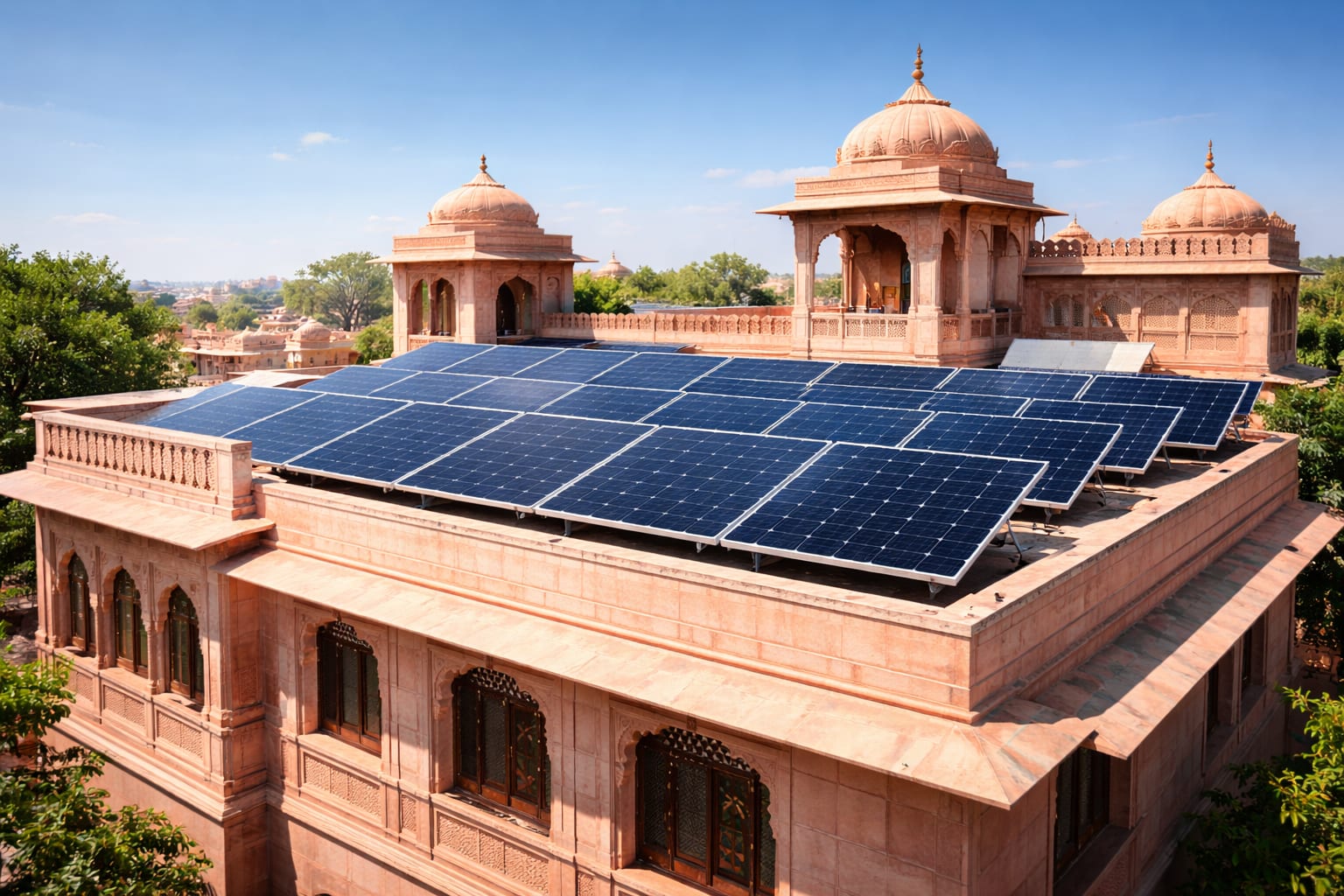
[Image Placeholder 1: Traditional Jaipur pink building with modern solar panels on rooftop, clear blue Rajasthan sky, architectural blend of heritage and modern technology] Alt text: Rooftop solar panel installation on traditional Jaipur residential building showing solar system in Pink City
Why Jaipur is Excellent for Solar Panels
Jaipur ranks among India's top 3 cities for solar energy potential due to exceptional climate conditions and favorable economics.
Jaipur's Peak Sun Hours and Climate
Jaipur's desert climate creates ideal conditions for solar power generation:
Annual sunshine days: 320-330 days of clear, strong sunshine
Peak sun hours: 6.5-7 hours daily average (among the highest in India)
Summer generation: 8-9 peak hours daily from March to September when you need it most for AC loads
Winter generation: 5-6 peak hours daily from November to February, still excellent compared to most Indian cities
Cloud cover: Minimal compared to coastal or mountainous regions. Monsoon (July-August) is the only period with significant cloud impact.
Air quality: While Jaipur has pollution in winter months, it's significantly lower than Delhi. Dust is the bigger concern, but regular cleaning maintains performance.
To put this in perspective, a 3 kW system in Jaipur generates approximately 4,600-4,900 units annually. The same system in Mumbai generates 3,800-4,100 units, and in Kolkata just 3,500-3,800 units. Jaipur gives you 20-30% more electricity generation for the same investment.
Jaipur's dry heat is also advantageous. Yes, panels lose some efficiency at 45°C (panels work best at 25°C), but the long sunshine hours more than compensate. A typical summer day gives you 10-11 hours of sunlight even after accounting for temperature efficiency loss.
JVVNL Electricity Rates in Jaipur
Jaipur comes under Jaipur Vidyut Vitran Nigam Limited (JVVNL) for electricity distribution. As of February 2026, the residential tariff structure is:
Slab 1 (0-50 units): ₹4.20 per unit + fixed charge ₹60
Slab 2 (51-150 units): ₹5.70 per unit + fixed charge ₹110
Slab 3 (151-300 units): ₹6.90 per unit + fixed charge ₹140
Slab 4 (301-500 units): ₹7.80 per unit + fixed charge ₹200
Slab 5 (Above 500 units): ₹8.50 per unit + fixed charge ₹250
Most Jaipur households with 2-3 BHK and AC usage consume 350-550 units monthly during summer (April to September), putting them in the ₹7.80-₹8.50 per unit bracket. This means summer bills of ₹6,000-₹9,000.
Even in pleasant winter months (November to February), consumption remains 200-280 units for heating, geysers, and regular appliances, leading to bills of ₹3,200-₹4,500.
These high rates make solar panels financially attractive. Every unit you generate saves you ₹6.90-₹8.50, much higher than cities with subsidized electricity.
Additionally, JVVNL has announced 6-8% tariff increases annually to cover power purchase costs. Your ₹7,000 bill today will likely be ₹9,500-₹10,000 by 2030 without solar. Solar locks in your electricity cost at today's rates for 25 years.
Solar Panel Installation Cost in Jaipur 2026
Solar panel costs in Jaipur are among the most competitive in India due to proximity to Gujarat and Rajasthan's manufacturing hubs, good installer competition, and state government push for solar adoption.
Price Per Kilowatt in Jaipur Market
The average cost per kilowatt in Jaipur ranges from ₹46,000 to ₹62,000 depending on component quality, roof complexity, and installer reputation.
Budget installations: ₹46,000-₹50,000 per kW using Rajasthan-based or Indian mid-tier brands (Premier Energies, Vikram Solar, Goldi Solar) with standard string inverters. These are ALMM-compliant and perform well in Jaipur's climate.
Mid-range installations: ₹51,000-₹56,000 per kW using premium Indian brands (Waaree premium series, Adani Solar, REC Solar) with quality inverters from Growatt, Sungrow, or Luminous.
Premium installations: ₹57,000-₹62,000 per kW using top international brands (Longi, Jinko, Canadian Solar) with hybrid inverters or microinverters for maximum efficiency.
Jaipur prices are 4-7% lower than Delhi and 8-12% lower than Mumbai, making it one of India's most affordable markets for quality solar installations. This is because:
Proximity to manufacturing: Gujarat (Waaree, Adani factories) is just 600 km away, reducing transportation costs.
Local installer competition: Jaipur has 80+ MNRE-empaneled installers competing for business.
Rajasthan government support: State policies favor solar, creating a mature, efficient market.
Lower labor costs: Compared to metros, Jaipur installation labor is 10-15% cheaper.
3kW System Cost in Jaipur
A 3 kW system is ideal for Jaipur homes consuming 300-450 units monthly. This suits most 2-3 BHK apartments or independent floors in areas like Mansarovar, Vaishali Nagar, or Malviya Nagar.
Total cost before subsidy: ₹1,38,000 to ₹1,86,000
PM Surya Ghar subsidy: ₹78,000
Your net investment: ₹60,000 to ₹1,08,000
What you get: 8-10 solar panels (each 335W-400W capacity), one 3 kW string inverter, aluminum mounting structure suitable for Jaipur heat, all wiring and safety equipment, net metering setup, and professional installation with warranty.
Monthly electricity generation in Jaipur: 400-430 units (13-14 units per day average, higher in summer, lower in monsoon)
Monthly bill savings: ₹2,800-₹3,400 at JVVNL's rates
Roof space needed: 240-280 square feet of shadow-free area
A typical Jaipur household with 3 kW sees their ₹5,500 summer bill drop to ₹900-₹1,400 and winter bill from ₹3,500 to ₹400-₹700.
Most Jaipur installers recommend 3 kW as the sweet spot for standard households. It covers 80-90% of your electricity needs, maximizes subsidy benefit (₹78,000 for 3 kW vs same ₹78,000 for 5 kW), and fits most residential rooftops comfortably.
5kW System Cost in Jaipur
A 5 kW system suits larger Jaipur homes with 3-4 BHK, multiple ACs, or independent houses in Civil Lines, C-Scheme, or Jagatpura consuming 550-750 units monthly.
Total cost before subsidy: ₹2,30,000 to ₹3,10,000
PM Surya Ghar subsidy: ₹78,000 (same maximum as 3 kW)
Your net investment: ₹1,52,000 to ₹2,32,000
What you get: 13-16 solar panels (400W each typically), one 5 kW inverter (string or hybrid), heavy-duty mounting structure, complete wiring and safety systems, net meter, and professional installation with comprehensive warranty.
Monthly electricity generation in Jaipur: 650-720 units (21-24 units per day, exceptional during Jaipur's long summers)
Monthly bill savings: ₹4,800-₹5,800 at JVVNL rates
Roof space needed: 420-480 square feet
Jaipur homes with 5 kW often eliminate electricity bills entirely for 9-10 months of the year. Even during peak summer with 24/7 AC usage, bills stay under ₹800-₹1,200.
The 5 kW option makes sense if you have high consumption, plan to add more electrical loads (like electric vehicle charging), or have ample roof space and want to future-proof your installation.
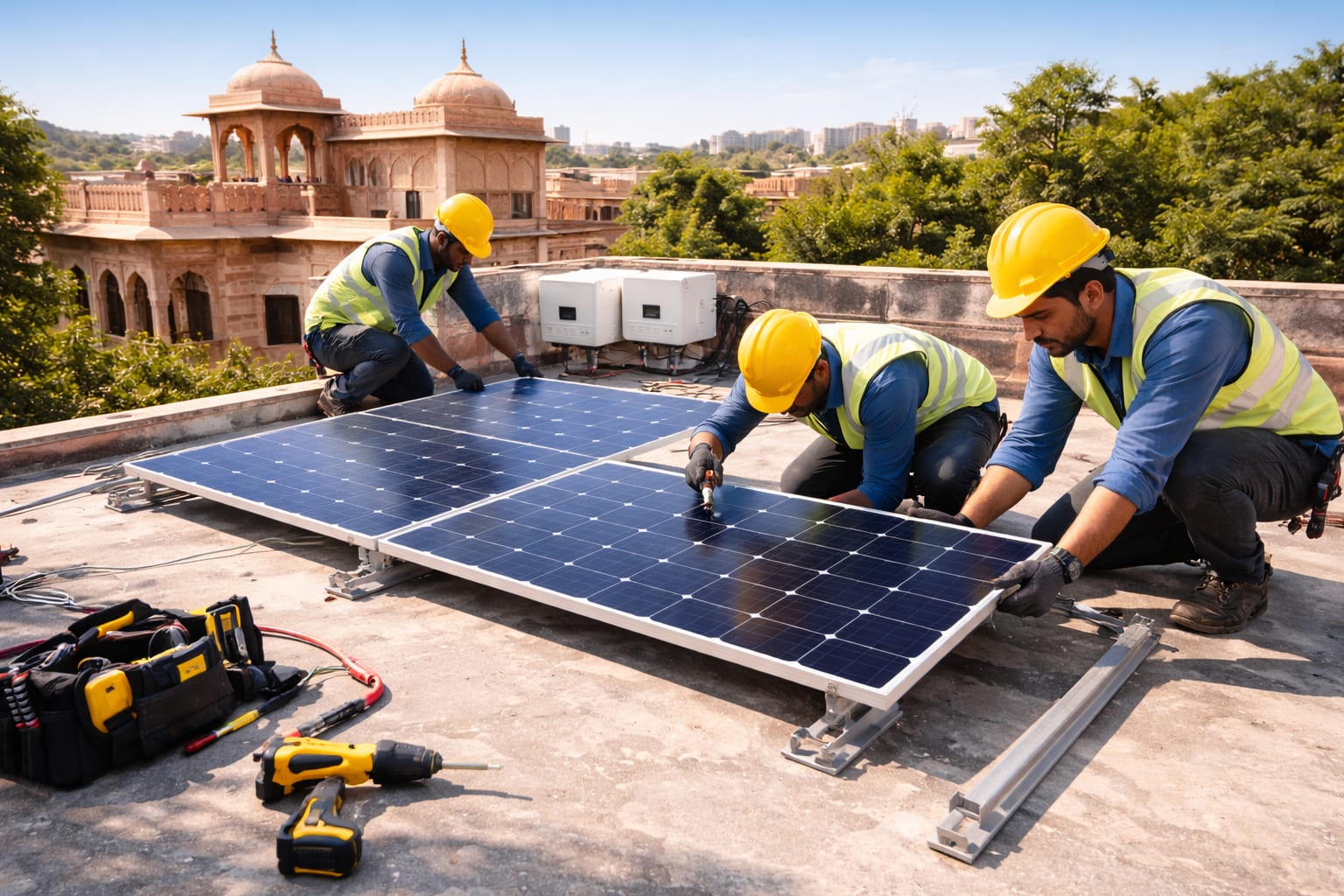
[Image Placeholder 2: Solar panel installation in progress on Jaipur residential rooftop, installation team in safety gear, RCC flat roof typical of Jaipur construction, blue sky] Alt text: Professional solar installation team installing rooftop solar panels on residential building in Jaipur Rajasthan
Component Costs in Jaipur's Solar Market
Understanding component pricing helps you negotiate better and identify if an installer is overcharging.
Solar Panel Brands Available in Jaipur
Jaipur has excellent availability of both budget and premium solar panel brands:
Rajasthan and Gujarat Made (Best value in Jaipur):
- Waaree Energies (Surat manufacturing): ₹22-₹27 per watt. Most popular brand in Jaipur due to Gujarat proximity, quick service, and proven performance in Rajasthan heat. 25-year warranty.
- Adani Solar (Mundra, Gujarat): ₹25-₹29 per watt. Premium efficiency (21-22%), excellent temperature coefficient for Jaipur summers. 25-year warranty.
- Goldi Solar (local Rajasthan brand): ₹20-₹23 per watt. Budget option, ALMM-approved, decent quality. 10+25 year warranty.
Other Indian Brands:
- Tata Power Solar: ₹27-₹30 per watt. Trusted name, good service network in Rajasthan. Slightly expensive due to brand premium.
- Vikram Solar: ₹21-₹24 per watt. Good mid-range option, proven track record.
- Premier Energies: ₹22-₹25 per watt. Hyderabad-based, growing presence in Jaipur market.
International Brands:
- Longi Solar: ₹25-₹28 per watt. World's largest manufacturer, highest efficiency (22-23%). Service through authorized Jaipur dealers.
- Jinko Solar: ₹24-₹27 per watt. Good quality, competitive pricing.
- Canadian Solar: ₹26-₹29 per watt. Premium option, excellent durability.
For a 3 kW system (approximately 8 panels of 375W), panel costs range from ₹60,000 (budget Goldi/Vikram) to ₹87,000 (premium Tata/Canadian Solar).
Jaipur installer recommendation: Most experienced Jaipur installers suggest Waaree or Adani for best balance of quality, price, and local service availability. Being Gujarat-made means faster warranty claims and better part availability.
Special consideration for Jaipur: Choose panels with lower temperature coefficient (how much efficiency drops in heat). Premium panels lose only 0.35% per degree Celsius above 25°C, while budget panels may lose 0.45%. In Jaipur's 45°C summers, this 0.10% difference compounds to 5-8% more generation over 25 years from premium panels.
Solar Inverter Prices in Rajasthan
Inverter availability and pricing in Jaipur:
String Inverters (Recommended for Jaipur's Clear Skies):
- Luminous (Indian brand): ₹32,000-₹40,000 for 3 kW, ₹50,000-₹65,000 for 5 kW. Strong service network in Jaipur with 3 service centers.
- Growatt (Chinese, Indian assembly): ₹30,000-₹38,000 for 3 kW, ₹48,000-₹62,000 for 5 kW. Very popular in Rajasthan, good value.
- Sungrow (Chinese): ₹33,000-₹42,000 for 3 kW, ₹52,000-₹68,000 for 5 kW. Premium quality, excellent efficiency.
- Delta (Taiwanese): ₹35,000-₹45,000 for 3 kW, ₹55,000-₹72,000 for 5 kW. Top-tier efficiency and reliability.
Hybrid Inverters (For Battery Backup Option):
- Luminous NXG series: ₹48,000-₹68,000 for 3 kW, ₹78,000-₹1,15,000 for 5 kW
- Growatt SPH series: ₹52,000-₹72,000 for 3 kW, ₹85,000-₹1,25,000 for 5 kW
Hybrid inverters make sense in Jaipur areas that occasionally face power cuts (some Mansarovar, Sanganer areas) or if you plan to add battery storage later.
Microinverters (For Shaded Roofs):
- Enphase: ₹10,000-₹13,000 per panel
- Total for 3 kW: ₹80,000-₹1,04,000
Only recommended if your Jaipur roof has unavoidable shading from water tanks, staircase structures, or neighboring buildings.
Most Jaipur installations use standard string inverters as rooftops here typically have excellent sun exposure without shading issues.
Installation Charges for Jaipur Homes
Labor and installation costs in Jaipur are reasonable:
Installation labor: ₹6,000-₹9,000 per kW for standard RCC flat roofs (most common in Jaipur residential areas).
For sloped roofs: ₹9,000-₹13,000 per kW. Some older Jaipur homes in Civil Lines, C-Scheme have sloped tile roofs requiring specialized mounting.
Net metering charges (JVVNL): ₹8,000-₹12,000 including bi-directional meter cost, installation, and JVVNL processing fees.
Mounting structure:
- Aluminum structure: ₹6,500-₹8,000 per kW (recommended for Jaipur's heat—better heat dissipation, no rust in monsoon)
- Galvanized Iron (GI): ₹4,800-₹6,500 per kW (economical but requires anti-rust coating for Jaipur monsoons)
Other installation costs:
- Earthing and lightning protection: ₹3,500-₹6,000 (important in Jaipur due to occasional thunderstorms)
- AC/DC cables and connectors: ₹8,000-₹13,000 for 3 kW
- Junction boxes, isolators, surge protection: ₹4,500-₹7,000
Total installation and balance-of-system costs for 3 kW in Jaipur: ₹32,000-₹48,000
Jaipur labor is 10-12% cheaper than Delhi/NCR and 15-20% cheaper than Mumbai, contributing to overall lower system costs.
Subsidies Available for Jaipur Residents
Jaipur residents can access both central and state subsidies, making solar extremely affordable.
PM Surya Ghar Central Subsidy
All Jaipur residents with JVVNL electricity connection are eligible for PM Surya Ghar Muft Bijli Yojana subsidy:
For 1 kW system: ₹30,000 subsidy
For 2 kW system: ₹60,000 subsidy (₹30,000 per kW)
For 3 kW or larger system: ₹78,000 maximum subsidy (₹60,000 for first 2 kW + ₹18,000 for next 1 kW)
This subsidy is available to all Jaipur homeowners regardless of income, caste, or social category. Requirements are:
- Residential JVVNL electricity connection
- Property ownership (or landlord NOC for tenants)
- ALMM-certified solar panels
- MNRE-empaneled installer
- Aadhaar-linked bank account for direct transfer
The subsidy is credited directly to your bank account within 30-90 days after JVVNL inspection. Jaipur's average subsidy disbursement time is 52-65 days as of February 2026, faster than the national average.
Rajasthan State Government Benefits
Rajasthan offers several additional benefits beyond the central PM Surya Ghar subsidy:
Expedited net metering: Rajasthan government has mandated JVVNL to complete net metering within 10 days of application for PM Surya Ghar beneficiaries. This is among the fastest in India.
Property tax rebate: Jaipur Municipal Corporation (JMC) and Jaipur Development Authority (JDA) offer 10% property tax rebate for homes with rooftop solar installations. For a ₹15,000 annual property tax bill, you save ₹1,500 annually.
Exemption from rooftop rent: In apartment complexes where societies charge rooftop usage fees, Rajasthan government mandates free rooftop access for individual flat owners installing solar under PM Surya Ghar.
Banking facility in net metering: JVVNL offers 90-day banking of surplus solar units (better than many states that offer only annual settlement). Your excess April generation can offset May-June consumption.
No standby charges: Some states charge ₹50-100 monthly as grid connectivity charges. Rajasthan has waived this for rooftop solar users.
While Rajasthan doesn't offer additional cash subsidy on top of PM Surya Ghar (unlike Gujarat's ₹10,000 extra), these benefits add ₹10,000-₹18,000 in value over the system's lifetime.
Additional Incentives for SC/ST Households
Rajasthan provides special benefits for SC/ST community members installing rooftop solar:
Additional state subsidy: ₹15,000 for 3 kW system, ₹20,000 for 5 kW system on top of PM Surya Ghar subsidy. This is available to SC/ST households with annual income below ₹2.5 lakh.
Priority processing: SC/ST applications receive priority at JVVNL for faster feasibility and net metering approval.
Free technical assistance: Rajasthan Renewable Energy Corporation Limited (RRECL) provides free technical consultation and site assessment for SC/ST applicants.
Subsidized loans: SC/ST households can access solar loans from Rajasthan Financial Corporation at 2% lower interest rates compared to general category.
Example: An SC/ST family in Jaipur installing 3 kW system can receive:
- PM Surya Ghar: ₹78,000
- Rajasthan SC/ST subsidy: ₹15,000
- Total subsidies: ₹93,000 for a ₹1,60,000 system
- Net investment: Just ₹67,000
To claim SC/ST benefits, you need to submit caste certificate along with your PM Surya Ghar application on the portal.
Best Solar Panel Installers in Jaipur
Jaipur has a mature solar market with many quality installers. Choosing the right one ensures smooth installation and subsidy process.
Top MNRE Approved Companies
Based on PM Surya Ghar installations, customer reviews, and experience, here are top-rated Jaipur installers:
Tata Power Solar (Direct):
- Cost: ₹56,000-₹62,000 per kW
- Installations in Jaipur: 800+ (as of Feb 2026)
- Service: Excellent, 3 service centers (Vaishali Nagar, Malviya Nagar, Mansarovar)
- Best for: Premium quality, guaranteed service, corporate clients
- Office: Plot 45, Malviya Nagar Industrial Area
Waaree Energies Authorized Partners:
- Cost: ₹49,000-₹56,000 per kW
- Installations in Jaipur: 1200+
- Service: Very good, authorized service network
- Best for: Best value for money, Gujarat-made panels
- Multiple dealer offices across Jaipur
Goldi Solar (Jaipur-based):
- Cost: ₹46,000-₹52,000 per kW
- Installations in Jaipur: 2000+ (local company, highest installations)
- Service: Excellent local support, same-day response
- Best for: Budget-conscious buyers, quick service
- Head office: Sitapura Industrial Area
Loom Solar:
- Cost: ₹52,000-₹58,000 per kW
- Installations in Jaipur: 500+
- Service: Good, tech-enabled monitoring
- Best for: Tech-savvy customers, app-based monitoring
- Service center: Vaishali Nagar
RenewSys India:
- Cost: ₹48,000-₹54,000 per kW
- Installations in Jaipur: 600+
- Service: Good, growing presence
- Best for: Mid-range quality, competitive pricing
- Office: Jagatpura
Jakson Green (formerly Jakson Engineers):
- Cost: ₹51,000-₹57,000 per kW
- Installations in Jaipur: 400+
- Service: Good, established company
- Best for: Commercial and large residential
- Office: C-Scheme
Rayzon Solar:
- Cost: ₹47,000-₹53,000 per kW
- Installations in Jaipur: 350+
- Service: Good
- Best for: Value pricing
- Office: Mansarovar
All these installers are MNRE-empaneled and eligible for PM Surya Ghar subsidy. You can verify their registration status at solarrooftop.gov.in before signing agreements.
How to Choose Right Installer in Jaipur
Get 3-4 quotations: Prices vary by ₹15,000-₹35,000 for the same 3 kW system across installers. Compare detailed written quotes.
Check MNRE registration: Only empaneled installers qualify you for PM Surya Ghar subsidy. Verify on official portal.
Visit completed installations: Ask for references in your area (Mansarovar, Vaishali Nagar, Malviya Nagar, etc.). Talk to actual customers.
Verify component brands: Ensure quote specifies exact panel model (not just "3 kW solar panels") and inverter brand. Get ALMM certification proof.
Warranty clarity: Get written warranty documents: 25 years panel performance, 5-10 years inverter, 5 years mounting structure, 1-5 years installation workmanship.
Payment terms: Standard Jaipur practice is 30% advance, 50% during installation, 20% after subsidy credit. Never pay 100% upfront.
Subsidy assistance: Installer should help with PM Surya Ghar portal application, but you should maintain control of your login credentials.
After-sales service: Ask about annual maintenance contracts (₹2,000-₹4,000 per year for cleaning and checkups), response time for issues, and complaint handling process.
Local presence: Prefer installers with physical Jaipur offices. Avoid Delhi or Mumbai-based companies operating remotely in Jaipur—service will be slow.
Red flags in Jaipur market:
- Extremely low quotes (below ₹44,000/kW)—likely using non-ALMM panels or will add hidden charges later
- Demanding full payment before installation
- No GST bill or proper company registration
- Promises of "guaranteed subsidy in 15 days"—unrealistic timeline
- Pushy sales tactics or door-to-door cold calling
Trust your instincts. If an installer seems too eager or too cheap, there's usually a reason.
Jaipur-Specific Installation Considerations
Jaipur's unique climate and architecture require special attention during solar installation.
Roof Types in Pink City Homes
RCC flat roofs (85% of Jaipur residential): Standard installation works well. Most Jaipur apartment complexes and independent floors have flat RCC roofs. Installation is straightforward with standard mounting structures. Ensure proper waterproofing around mounting bolt points to prevent leaks during monsoon.
Sloped tile roofs (Civil Lines, C-Scheme old homes): Some heritage and older Jaipur homes have sloped roofs with Mangalore tiles or terracotta. These require specialized tile-roof mounting systems. Installation cost increases by ₹15,000-₹25,000 for a 3 kW system. The advantage is better natural cooling and easier rainwater runoff. Ensure installer is experienced with tile roofs—improper installation can break tiles.
Terraced homes (common in walled city): Many old Jaipur homes in Johri Bazaar, Chandpole, Tripolia have multi-level terraced structures. Solar can be installed but requires careful planning to avoid shadows from higher levels. 3D shadow analysis is essential.
Compound walls and parking shades: Jaipur homes often have large compounds. If rooftop space is limited, consider mounting structures on parking shades or boundary walls facing south.
Penthouse terraces: Jaipur apartments increasingly have penthouses with terrace rights. These are ideal for solar but check building structural capacity—older buildings may need reinforcement for 300-400 kg additional load.
Summer Heat and Dust Management
Jaipur's extreme summers and desert dust are key challenges:
Temperature impact: Jaipur reaches 45-48°C in May-June. Solar panels lose 0.3-0.5% efficiency for every degree above 25°C. On a 45°C day, panels operate at 8-12% lower capacity than rated. Choose panels with low temperature coefficient—premium panels maintain better performance in Jaipur heat.
Cooling gap: Ensure minimum 6-8 inches gap between roof and panels for air circulation. This cooling gap helps dissipate heat and improves efficiency by 3-5% in Jaipur summers. Aluminum mounting structures provide better heat dissipation than GI.
Dust accumulation: Jaipur's desert location means significant dust accumulation, especially during April-June. Dust layers can reduce output by 15-25% if not cleaned.
Cleaning schedule for Jaipur:
- Summer (March-June): Clean every 15-20 days
- Monsoon (July-September): Clean once at monsoon end
- Winter (October-February): Clean every 30-40 days
Use soft brush or sponge with plain water. Avoid harsh chemicals or pressure washing that can damage panel coating. Many Jaipur installers offer annual maintenance contracts (₹2,500-₹4,500) including cleaning.
Hydrophobic coating: Some premium installers offer nano-coating (₹3,000-₹5,000) that makes panels dust-repellent and easier to clean. Worth considering for Jaipur.
Monsoon Preparation for Jaipur
While Jaipur's monsoon is mild (average 600-650mm rainfall annually), proper preparation prevents damage:
Waterproofing: Apply waterproof sealant around all mounting bolt penetrations on roof. This prevents water seepage into the building during heavy downpours.
Drainage: Ensure water doesn't pool around panel bases. Jaipur's sudden heavy rains can create temporary water accumulation. Proper slope and drainage channels are essential.
Earthing and lightning: Jaipur experiences occasional thunderstorms during monsoon. Proper earthing (₹4,000-₹6,000) and lightning arrestors (₹3,000-₹5,000) protect expensive equipment.
Structure stability: Mounting structures must withstand 150-180 km/h wind speeds (Jaipur meteorological data for extreme events). Use heavy-duty aluminum or galvanized structures with proper roof anchoring.
Pre-monsoon inspection: Get installer to inspect all connections, tighten loose bolts, and check earthing before monsoon arrives (usually early July).
Most quality installers in Jaipur provide 5-year workmanship warranty covering monsoon-related structural issues.
Net Metering Process in Jaipur (JVVNL)
JVVNL's net metering process for Jaipur has improved significantly under PM Surya Ghar implementation.
How to Apply for Net Metering
Step 1 - Online application: When you apply on pmsuryaghar.gov.in, the portal automatically submits your net metering request to JVVNL. No separate application needed.
Step 2 - Feasibility assessment: JVVNL technical team assesses your installation location, roof suitability, and existing grid capacity within 5-12 days.
Step 3 - Feasibility approval: You receive digital feasibility approval on the PM Surya Ghar portal and via email/SMS. This includes preliminary net metering approval.
Step 4 - Install system: After getting feasibility approval, complete your solar installation through MNRE-empaneled installer.
Step 5 - Installation completion intimation: Upload installation photos and completion certificate on PM Surya Ghar portal. This triggers JVVNL inspection request.
Step 6 - JVVNL inspection: JVVNL engineer visits within 7-15 days to inspect installation quality, safety compliance, and system specifications.
Step 7 - Net meter installation: After successful inspection, JVVNL installs bi-directional net meter within 5-10 days, replacing your existing meter.
Step 8 - System commissioning: JVVNL activates net metering. You're now exporting excess power to grid and earning credits.
Timeline and Charges
Total timeline for net metering activation in Jaipur: 12-20 days from installation completion to net meter activation. Rajasthan is among the fastest states.
JVVNL net metering charges:
- Net meter cost: ₹6,500-₹8,500 (single-phase for most homes)
- Installation charges: ₹1,500-₹2,500
- Testing and commissioning: ₹1,000-₹1,500
- Total: ₹9,000-₹12,500
These charges are included in most installer quotations as "net metering setup cost."
Net metering benefits in Jaipur:
Banking facility: JVVNL allows 90-day banking of surplus units. Excess generation in April can offset consumption in May, June, and July. This is better than states offering only annual settlement.
Annual settlement: At financial year-end (March 31), if you have surplus units remaining after 90-day banking adjustments, JVVNL credits you at ₹3.20 per unit (approximately 40% of retail tariff).
Example: Your 5 kW system generates 700 units in April. You consume 550 units. The extra 150 units are banked. In May, you generate 680 units and consume 720 units. The banked 150 units from April cover your 40-unit deficit in May. At year-end, if you still have surplus, you get ₹3.20 per unit.
No capacity limit: JVVNL allows net metering up to your sanctioned load. If your home has 5 kW sanctioned load, you can install 5 kW solar with net metering.
Seamless integration: The net meter works automatically. You don't need to do anything—export and import happen based on real-time generation and consumption.
JVVNL's net metering policy is among India's most homeowner-friendly, making solar investment very attractive in Jaipur.
Return on Investment for Jaipur Homeowners
Jaipur's excellent sunshine and high JVVNL rates create exceptional solar ROI.
Monthly Electricity Bill Savings
Let's calculate realistic savings for typical Jaipur households:
Example 1: 3 BHK Apartment in Mansarovar
- Current consumption: 420 units/month summer, 250 units/month winter
- Current bills: ₹6,300 summer (₹7.50 avg rate), ₹3,600 winter
- 3 kW solar installed
- Solar generation: 420 units/month average (higher in summer, lower in monsoon)
- New consumption from grid: 0-30 units in summer, 0-10 units in winter
- New bills: ₹300-₹600 including fixed charges
- Monthly savings: ₹5,700-₹6,000 in summer, ₹3,000-₹3,300 in winter
- Annual savings: ₹52,000-₹56,000
Example 2: 4 BHK Independent House in Vaishali Nagar
- Current consumption: 680 units/month summer, 380 units/month winter
- Current bills: ₹10,500 summer, ₹5,200 winter
- 5 kW solar installed
- Solar generation: 680 units/month average
- New consumption from grid: 0-50 units summer, 0-20 units winter
- New bills: ₹400-₹800
- Monthly savings: ₹9,700-₹10,100 in summer, ₹4,400-₹4,800 in winter
- Annual savings: ₹85,000-₹92,000
Example 3: 2 BHK Flat in Malviya Nagar (No AC)
- Current consumption: 260 units/month summer, 180 units/month winter
- Current bills: ₹3,800 summer, ₹2,400 winter
- 2 kW solar installed
- Solar generation: 270 units/month average
- New consumption from grid: 0-15 units
- New bills: ₹200-₹400
- Monthly savings: ₹3,400-₹3,600 in summer, ₹2,000-₹2,200 in winter
- Annual savings: ₹32,000-₹35,000
These calculations assume net metering where excess summer generation offsets winter deficit. Actual savings vary based on consumption patterns, AC usage, and household size.
Payback Period Calculation
3 kW System in Jaipur:
- Total cost: ₹1,60,000
- PM Surya Ghar subsidy: ₹78,000
- Net investment: ₹82,000
- Annual savings: ₹54,000 (average household)
- Payback period: 1.5 years
- Profit over 25 years: ₹12,18,000
5 kW System in Jaipur:
- Total cost: ₹2,70,000
- PM Surya Ghar subsidy: ₹78,000
- Net investment: ₹1,92,000
- Annual savings: ₹88,000 (average household)
- Payback period: 2.2 years
- Profit over 25 years: ₹19,08,000
Jaipur has one of India's shortest payback periods due to:
- High JVVNL electricity rates (₹7-8.50/unit)
- Excellent solar generation (6.5-7 peak sun hours)
- Competitive installation costs
- Generous subsidies
Compare this to national average payback of 3.5-4 years. Jaipur homeowners recover investment 40-50% faster.
25-Year Profit Projection
Solar panels are guaranteed to produce electricity for 25+ years. Here's long-term profit for a 3 kW system in Jaipur:
Year 1-5:
- Annual savings: ₹54,000 (electricity rates increasing 6% annually)
- Total savings: ₹2,88,000
- Less investment: ₹82,000
- Net profit by Year 5: ₹2,06,000
Year 6-15:
- Annual savings: ₹62,000-₹98,000 (as tariffs increase)
- Total additional savings: ₹7,50,000
- Cumulative profit by Year 15: ₹9,56,000
Year 16-25:
- Annual savings: ₹1,05,000-₹1,52,000
- Panel degradation: 0.5% annually (minimal impact)
- Total additional savings: ₹11,80,000
- Final 25-year profit: ₹21,36,000
This assumes:
- 6% annual JVVNL tariff increase (conservative based on historical data)
- 0.5% annual panel degradation (standard for quality panels)
- ₹15,000 maintenance costs over 25 years (cleaning, minor repairs)
- One inverter replacement in Year 12-15 (₹35,000)
Even accounting for maintenance and inverter replacement, a ₹82,000 investment turns into ₹21+ lakh profit over 25 years. That's 2,500% return on investment.
Real estate in Jaipur gives 8-12% annual returns. Fixed deposits give 6-7%. Solar gives 30-40% annual returns in initial years, settling to 15-20% over the long term.
Area-Wise Solar Installation in Jaipur
Different Jaipur localities have unique characteristics affecting solar installation.
Mansarovar and Vaishali Nagar
Characteristics: Planned residential sectors, mostly RCC flat roofs, good JVVNL infrastructure
Average system size: 3-5 kW (mixed apartments and independent floors)
Installation considerations: Standard installations work well. Most buildings have clear rooftops without shading issues. RWA permissions are generally smooth in well-managed societies.
Local installers: Goldi Solar (Sitapura nearby), multiple Waaree dealers, Loom Solar service center in Vaishali
Average installation cost: ₹48,000-₹54,000 per kW
JVVNL response time: 12-18 days for net metering (better than Jaipur average)
Popular choice: 3 kW systems dominate, with growing interest in 5 kW for larger independent houses
Malviya Nagar and Jagatpura
Characteristics: Dense residential area, mix of old and new construction, some older buildings with space constraints
Average system size: 2-3 kW (smaller rooftops)
Installation considerations: Some buildings have limited shadow-free roof space due to water tanks, staircase structures. Requires careful panel placement and 3D modeling.
Local installers: Tata Power service center in Malviya Nagar, RenewSys office in Jagatpura, multiple local MNRE-empaneled installers
Average installation cost: ₹47,000-₹53,000 per kW
JVVNL response time: 15-20 days
Popular choice: 2-3 kW systems, occasionally microinverters needed for partial shading
Civil Lines and C-Scheme
Characteristics: Premium locality, mix of heritage homes and modern construction, some sloped roofs, large independent houses
Average system size: 5-10 kW (larger homes, higher consumption)
Installation considerations: Heritage buildings may need JDA/JMC permissions for aesthetic compliance. Sloped tile roofs common, requiring specialized mounting. Plenty of roof space available.
Local installers: Tata Power Solar (preferred by premium segment), Waaree authorized dealers, Jakson Green (C-Scheme office)
Average installation cost: ₹52,000-₹62,000 per kW (higher due to premium service expectations and complex roofs)
JVVNL response time: 12-15 days (priority area)
Popular choice: 5-7 kW systems, hybrid inverters for backup, premium international panels
Special consideration: Some Civil Lines homes are heritage properties requiring Jaipur Municipal Heritage approval before installation. Process adds 15-30 days but is manageable.
Other notable areas:
Sanganer: Industrial area transitioning to residential, good installer availability, competitive pricing (₹46,000-₹50,000/kW)
Sodala and Jhotwara: Developing residential areas, standard installations, growing solar adoption
Bani Park and Raja Park: Older residential areas, mix of building types, moderate solar penetration
Sitapura Industrial Area: While primarily industrial, nearby residential areas benefit from proximity to installer offices and warehouses
Regardless of location, ensure your installer is familiar with your specific area's JVVNL sub-division office procedures. Some sub-divisions are faster than others for net metering approvals.
Conclusion
Solar panel installation in Jaipur costs between ₹1,38,000 and ₹1,86,000 for a 3 kW system before the ₹78,000 PM Surya Ghar subsidy. Your net investment of just ₹60,000-₹1,08,000 pays for itself in 1.5-2 years through electricity bill savings. Jaipur's exceptional 6.5-7 peak sun hours daily and high JVVNL rates of ₹7-8.50 per unit make rooftop solar one of the most profitable home investments in the Pink City.
Key takeaways for Jaipur homeowners: Take advantage of excellent local installer availability and competitive pricing. Use ALMM-certified panels (Waaree and Adani are popular choices in Jaipur market). Apply through PM Surya Ghar portal for fast subsidy processing. Plan for regular dust cleaning during Jaipur summers. JVVNL's efficient net metering and 90-day banking facility maximize your savings.
Ready to eliminate your electricity bills? Contact MNRE-empaneled Jaipur installers like Goldi Solar, Waaree dealers, or Tata Power for site assessment. Register at pmsuryaghar.gov.in for ₹78,000 subsidy. Start generating free electricity from Jaipur's abundant sunshine and save ₹50,000-₹90,000 annually.


